Chili's Mythical Run Teardown

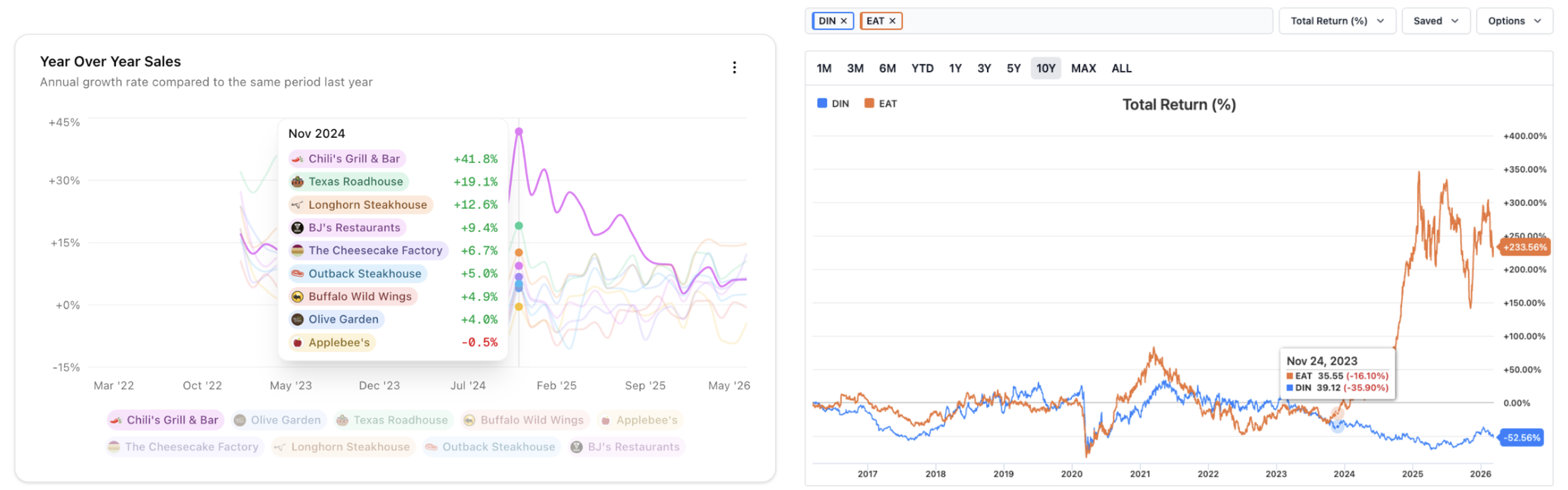
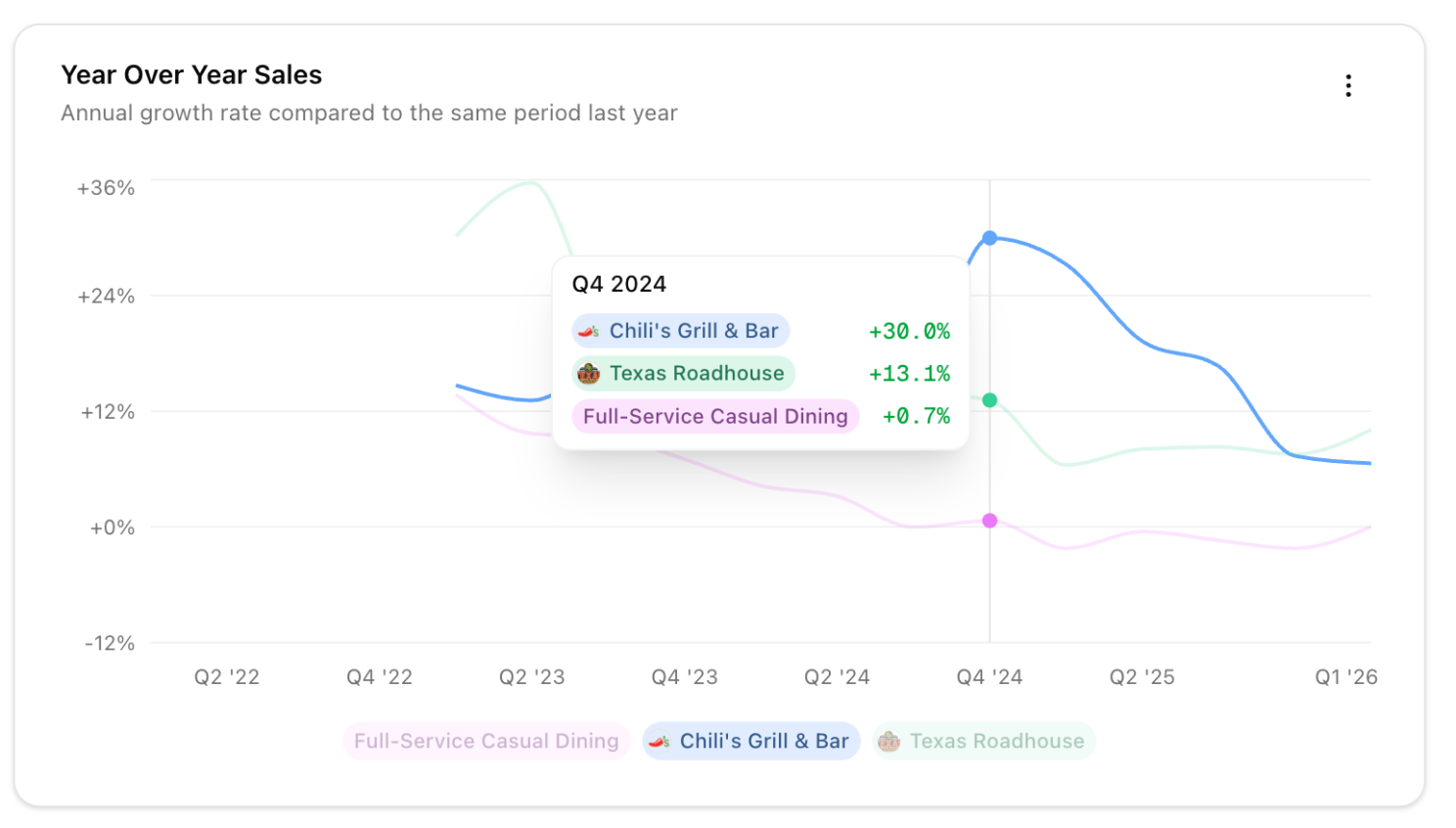
Chili’s caught my eye when I saw them top 35% YOY sales growth in November 2024. The answer? A viral TikTok “cheese pull” trend. Turns out, that was only the tip of the iceberg.
Chili’s mythical run has been four years in the making, starting with the hiring of former Yum! Brands exec Kevin Hochman as CEO. An absolute masterclass in “sequencing = success”. I analyzed every earnings call since 2022, podcasts, exec interviews, and billions of credit/debit card transactions via the PersonaLive platform to distill Chili’s strategy. From 2022 to Q1 2026 Chili’s achieved:
- - 58% reduction in guests with a problem
- - 25% reduction in menu items
- + 7% traffic Growth
- + 14% same store sales
- +113% restaurant level profitability
- +3.00 market share growth
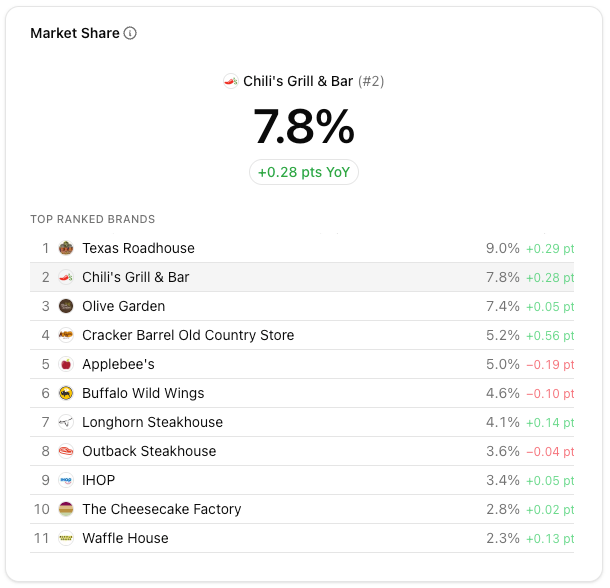
As of writing this, Chili’s has passed Olive Garden for the #2 marketshare spot.
Four threads run through this teardown:
The sequence in which Hochman went about turning around the company allowed him to free up the cash to both increase sales and decrease costs across a four year time span.
The enemy. Chili’s stopped competing with Applebee’s and picked an overt fight with fast food in their pricing and advertising. They knew people were fed up with fast prices. The result was winning share from Chipotle and McDonalds.
The warning. The same data that spotted the breakout early is flashing again. And this time it is not good news. Chili’s is slowly raising the prices that made the magic work. And you can see the strain in retention before you see it in market share.
The freeze. Chili’s has stalled opening new locations till 2028 while competitors are planning 50 - 75 in favor of remodels and getting average unit volume “North Of Six”.
But is the foundation solid? Beef prices are rising. Value wars are squeezing margins. The remodeling strategy is unproven. Are they fighting a race to the bottom with fast food while Texas Roadhouse and Longhorn are compounding right past them?
Let’s dig in.
Get the data and insights that built this teardown here.
Analyzing The Turn Around
Chili's opened its first location in Dallas in 1975. Brinker acquired it in 1983, and it has since grown past 1,200 locations. After an industry wide slump, the company brought in Hochman in 2022 to lead a turnaround. Since Q1 2022 they have grown 3.0 points of market share and, until November 2025, had the highest year over year sales in full service casual dining.
Hochman’s approach to the turn around is something that could be plug and play for any restaurant, and I can’t help but think he learned this while being a key marketer behind Taco Bell’s value stack:
- Fundamentals: Reduce useless complexity & costs
- Value proposition: Everyday value message to compete against fast food.
- Menu innovation: “Five to drive” slash 25% menu and focus on five areas.
- Brand amplification: Reinvest in national media.
Going after these in order fixed unit economics, experience, and demand. Watch how each step pays for the next.
Fixing Unit Economics
Hochman made its “simplify to execute” strategy concrete in SEC filings: “eliminate tasks that are unnecessary,” simplifying the menu to emphasize the core four, and scheduling more staff per shift to improve hospitality.”
Look at this reduction of costs as a percent of sales.
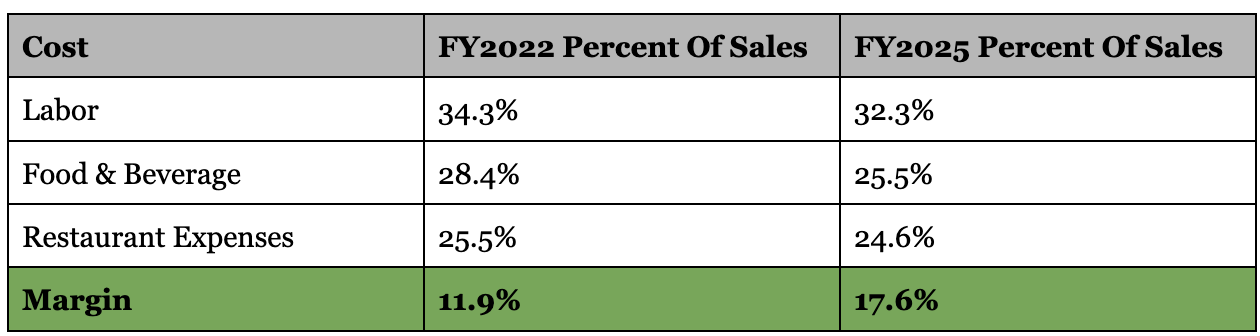
The FY2025 10-K and interviews describe a series of tiny changes behind those numbers: new shakers that season fries in fewer shakes, cheaper pickle packaging, and of course the 25% smaller menu. With food costs rising, they bundled high cost items like steak and poultry with higher margin foods, pulling more profit per guest. Most important, they went after costs sequentially. By FY2025 they had layered in an incremental $160 million of investment versus 2022, offset by the traffic pouring in.
Fixing Experience
Chili's north star metric is called Guests With A Problem. It dropped from roughly 5% before 2022 to 2.1% by Q2 FY2026. A smaller, simpler menu made for a better guest experience, and Hochman said getting this number right was the gate before stepping on the marketing gas.
When reducing the menu 25% they put the primary focus on the “five to drive”: Burgers, Crispers, Fajitas, Margaritas, and Triple Dipper. Focusing their innovation on these five menu items and reducing training on other items and improving the quality of those.
This is a bigger deal than what it seems like on the surface, they were explicitly saying no to a menu driven marketing calendar that focuses on limited time offers.
Fixing Demand
Hochman took an unorthodox path in the face of rising food costs. While the rest of casual dining moved upmarket and raised prices, he doubled down on value and aimed at fast casual brands like Chipotle and fast food brands like McDonald's.
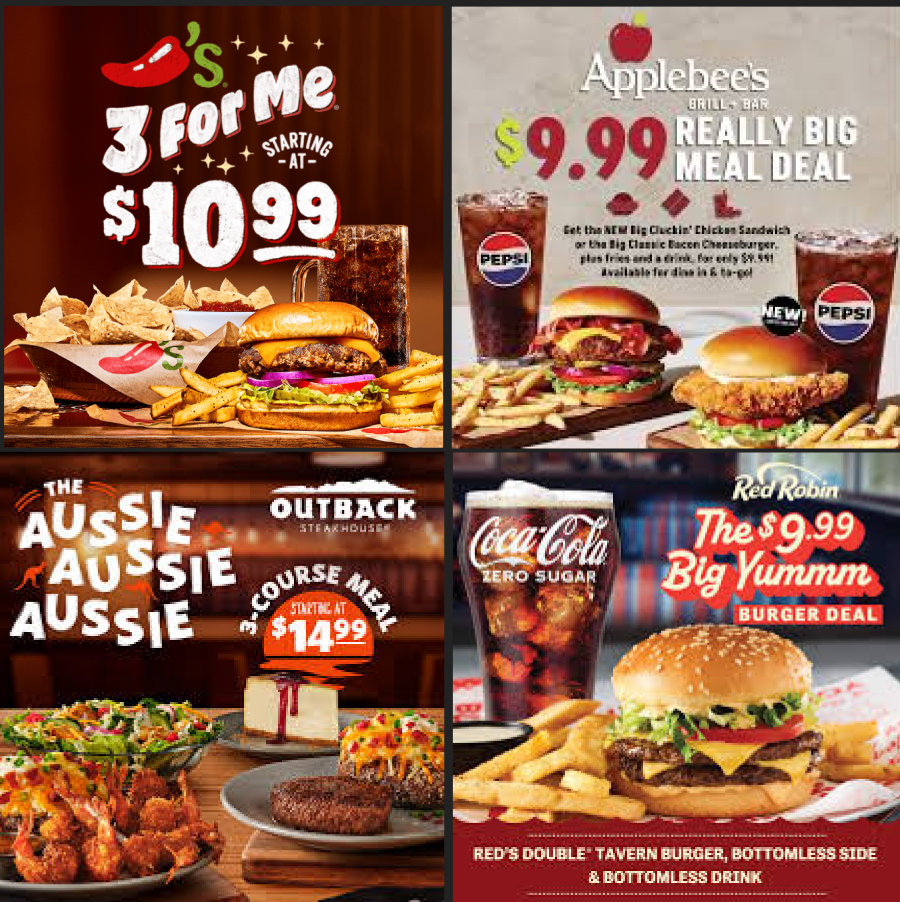
The center was the $10.99 3 For Me, which predated Hochman but became his focus. A guest gets a drink, an appetizer, and an entree, and can add upgrades for a fee. It brings people in the door and lets Chili's compete for a dollar that used to go to fast food. The results: 7% traffic growth and 14% same store sales growth.
A viral moment preceded investment in national advertising
The viral tiktok cheese pull trend surfaced organically in spring 2024 hitting its height in November. But by the time it hit Chili’s was already well staffed, with excellent economics. The cheese sticks saw 70% menu item growth - but more importantly, Chili’s was ready, and repeat visits grew. The Chili’s team poured fuel on the fire with social campaigns and influencer partnerships.
Perhaps in response to the viral test run, Chili’s stepped out in national advertising increasing their budget from 32 million in 2022 to 137m in 2025. Their themes centered around “value wars” showing their Big QP burger compared to McDonalds quarter pounder explicitly putting them in competition with fast food and striking a chord with consumers growing irritation with rising fast food prices.
All of these operational improvements set the stage for the mythical run.
Case
The turnaround began with a simple observation: fast food had become expensive.
By the early 2020s, a combo at McDonald's or a bowl at Chipotle crept up to $10 to $15, erasing the price gap between fast food and casual dining. Hochman saw that this changed the value equation. If people were already paying casual dining prices for fast food, Chili's could reposition as the better deal: a full restaurant experience at roughly the same price.
The product strategy had three parts. Cut the menu 25%. Anchor the price at $10.99. Focus marketing on evergreen hero products.
The most important product was 3 For Me. Unlike most restaurant promotions, it was not a limited time deal. It became a permanent price anchor that reset what people thought Chili's cost. Next to it sat the Triple Dipper, a customizable appetizer sampler. Felix said on an NPR interview when mozzarella stick cheese pull went viral, the item surged to roughly 14% of Chili's total sales.
Together these products answered a clear job to be done: when you want something better than fast food, still affordable, and worth leaving the house for.
Category
Since 2022, full service casual dining has averaged 4% growth a year. The nine companies in this study averaged 5.5%. Growth surged after covid and has now slowed to almost nothing. Chili's rode the same wave but pulled clearly away at the cheese pull moment: as the category stalled to 0.7% growth, Chili's was up 30%. Texas Roadhouse and Longhorn eclipsed them in year over year growth in Q1 2026. More on that later.
Gaining From The Losers
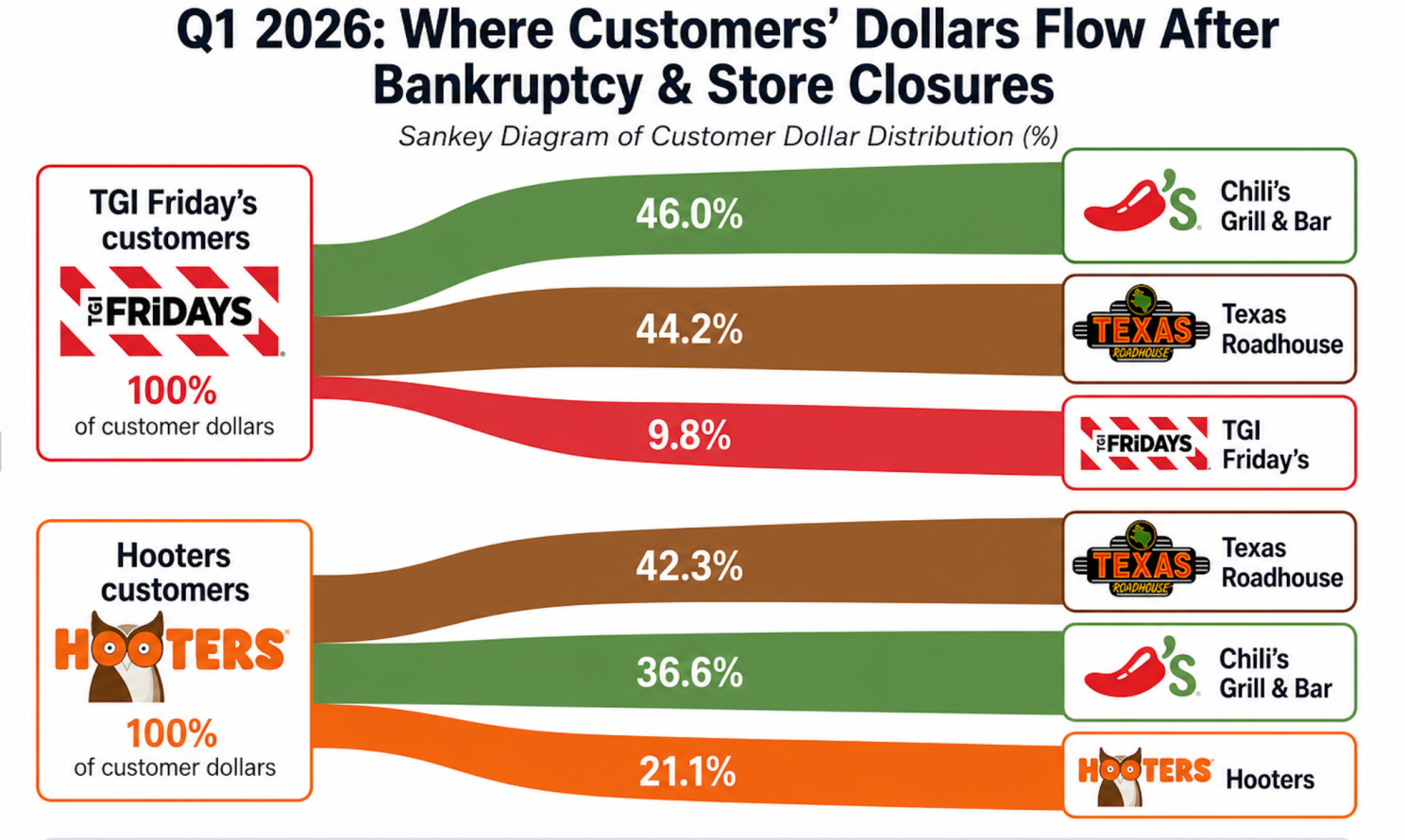
The category slowdown traces to major store closures, led by TGI Fridays and Hooters. The industry is shedding its weakest units, and share of wallet analysis lets us follow those customers as their old favorites went dark. As TGI Fridays collapsed from 44% of its customers' spending down to 10%, Chili's and Texas Roadhouse absorbed almost all of it. Chili's edged ahead, growing its share of the Fridays wallet 63%, just past Texas Roadhouse's 61%. Hooters told the mirror image story: as it fell from 47% to 21%, Texas Roadhouse took the bigger piece, up 52% against Chili's 48%. Each brand pulled hardest on the customers that most resembled its own.
Growing Outside The Category
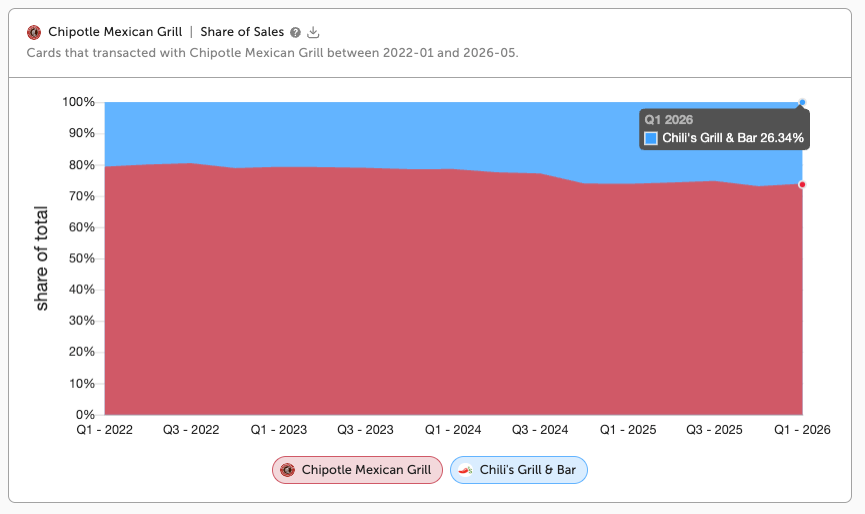
Just like their strategy would suggest, Chili’s growth didn’t just come from other casual dining chains. It also came from acquiring customers outside their category. Chili’s increased their share of wallet from Chipotle customers by 6% (from 20% - 26%) and their share of McDonalds customers dollars by 3% in the same time period.
Three For Me & The Coming Headwind
Competitors have tried to copy 3 For Me, but most copied the mechanics, not the strategy. Some run value bundles as limited time offers. Others compete purely on price and give up margin. Some price too high to touch fast food. Chili's efficiency work let it land in the middle: low enough to reset the comparison, profitable enough to keep it permanent.
Counterintuitively, the $10.99 bundle also produced faster ticket growth than the competition. Tickets rose from about $40.83 to $51.81 for Chili's between 2022 and 2026, versus $44.18 to $48.66 for Applebee's. Hold that thought. It matters later.
The nearest headwind is beef, expected to rise 12.1% in 2026. Chili's won by holding a fixed $10.99 price. Rising beef attacks exactly that.
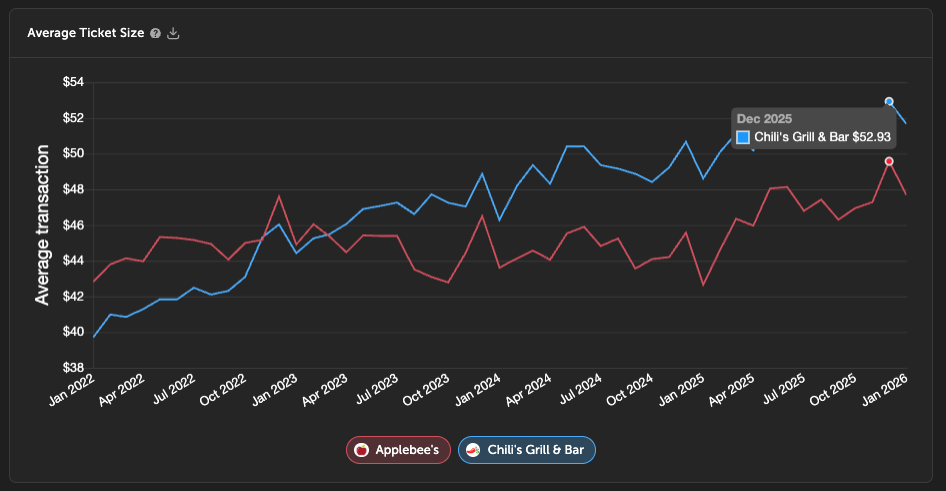
Chili's won by lowering costs and redrawing the boundaries of casual dining. Rising tickets might look like a healthy signal. To me it is an early warning sign. Which raises the question: who is their customer, and will they notice?
Customers
Analyzing Chili's customers through credit and debit card spend, we see a brand that closely matches its category and wins with a younger crowd in ways other restaurants are not. There are a few category gaps with rural and wealthy consumers, and the data says they are on their way to closing them.
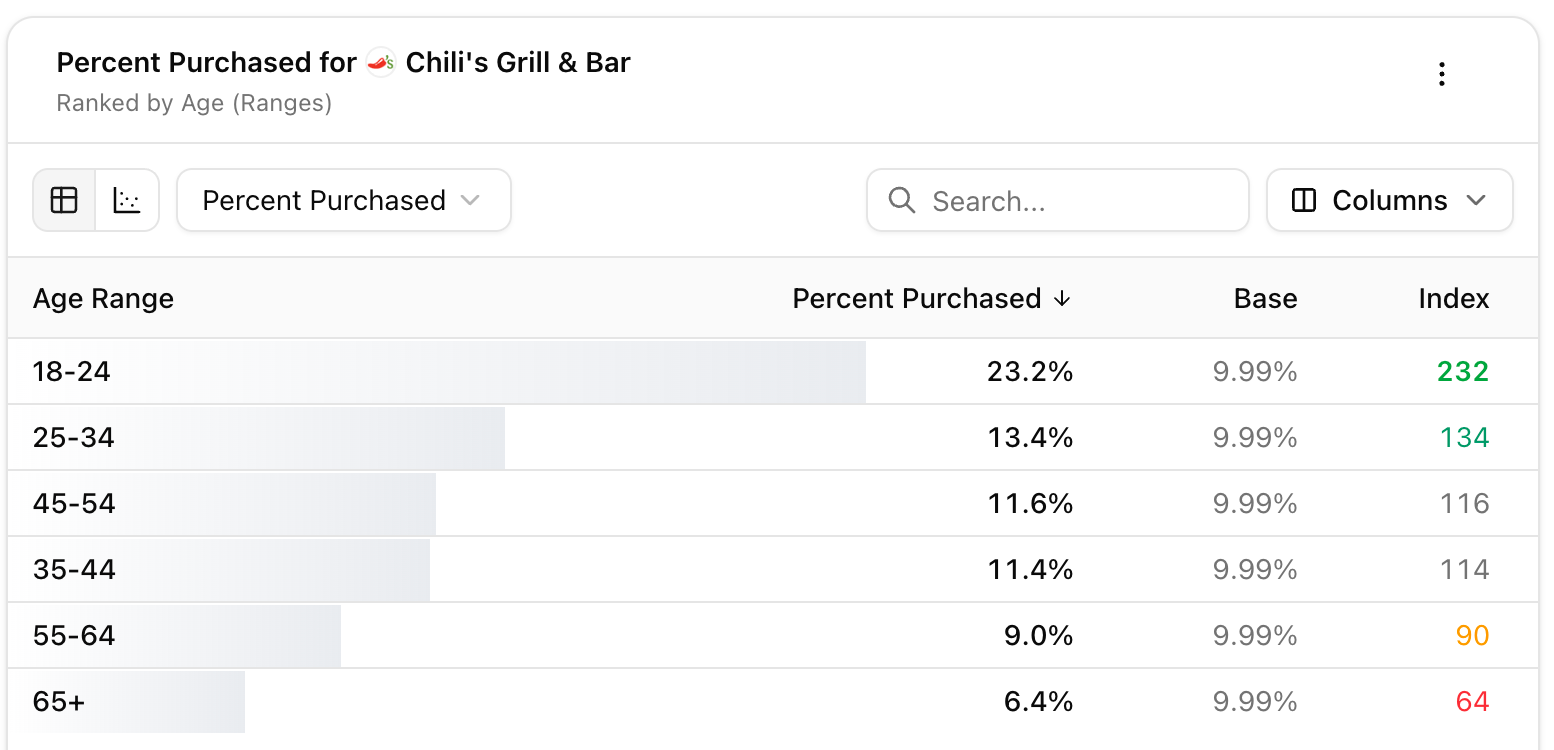
Age: Chili's runs young. The indexes fall in near perfect inverse order of age, with the biggest category gap on the youngest cohorts. Penetration backs it up: a full 23% of 18 to 24 year olds bought from Chili's in the past 12 months. Worth noting for later: younger diners are sensitive to price.
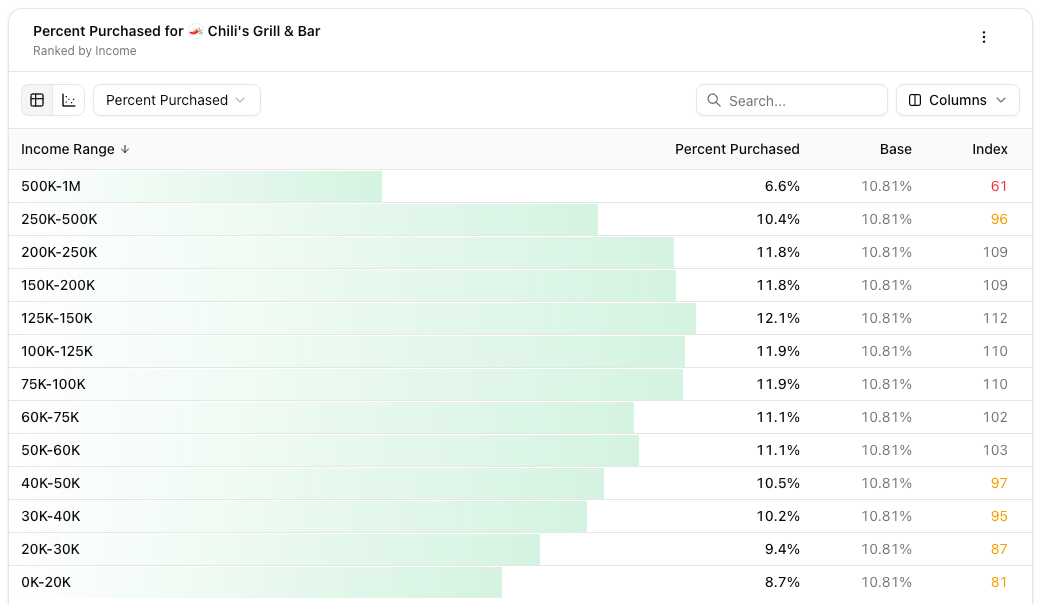
Income: With income we see a less extreme story. Chili’s sells across income cohorts, but centers around middle income. They under-index the category in their revenue share at the ends, both low and high income.
Segments: Chili's segments largely mirror the category, which is typical of brands near the top of the market share rankings. They over-index with Hispanic, blue collar, segments and are at category parity with wealthy suburban households. But at Chili's scale, the story is less about where you win and more about where you should be filling gaps. Two stand out, both large segments for the category and both places Chili's under-punches: rural high income and ultra wealthy families. That is where the next point of share is hiding.
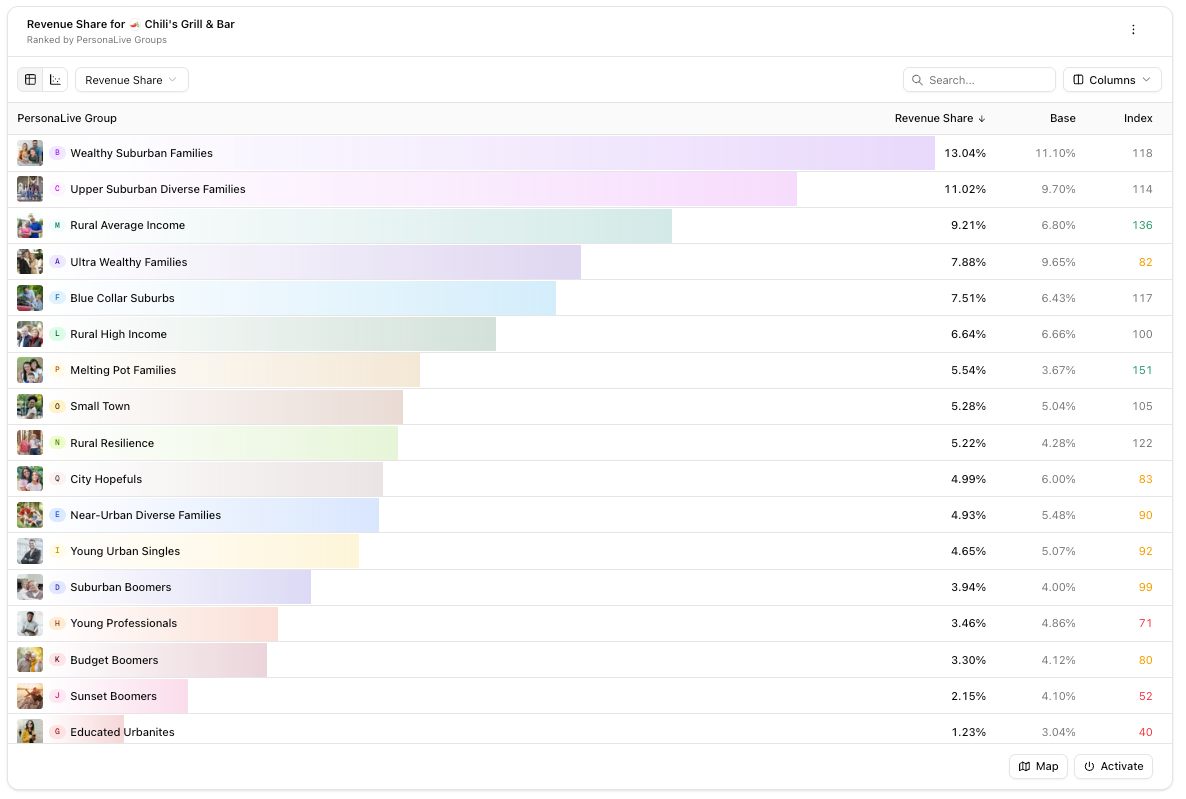
Segments Growth: All segments grew over the time period but overall Chilis had the most growth in the most critical segments, showing they are on the path to closing the category gap. By growth rate, the fastest-growing segments were Rural Average Income (+84%), Ultra Wealthy Families (+82%), and Wealthy Suburban Families (+80%). All three grew well ahead of Chili's overall 72%, meaning they gained share within Chili's own book of business.
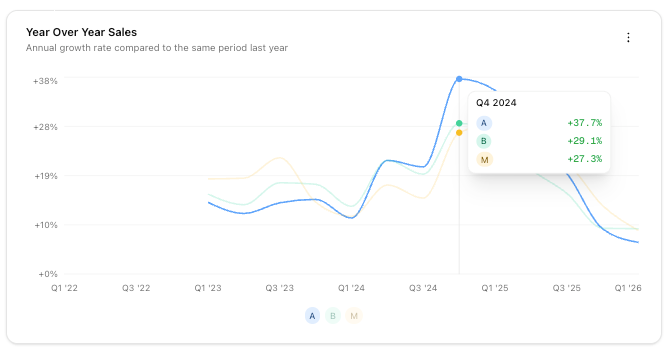
Chili’s seems to be going in the right direction, growing their biggest revenue driving segment (B- Wealthy Suburban Families) and closing category gaps. But a huge chunk of their past 12 month crowd are sensitive to price increases.
Competition
Here is where we can start to see the effect of the price increases on Chili’s customers.
Chili’s has reigned king in year over year growth since their breakout in May 2024, but starting December 2025 has been consistently outpaced in YOY sales by Longhorn Steakhouse, Texas Roadhouse, and Olive Garden.
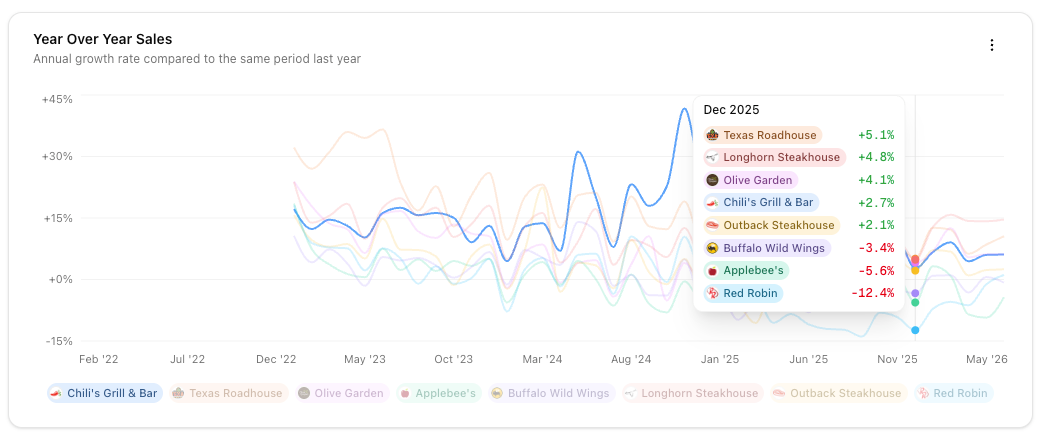
Although the drop in YOY growth comes from Chili’s lapping smaller numbers in the previous year, Chili’s still hit all time sales highs in the month of May. Texas Roadhouse and Longhorn Steakhouse actually beat Chili’s in trailing twelve month dollars added, by 98% and 25% respectively, Longhorn is doing it off a smaller base.
Dissecting the Steakhouse Surge
So how did Longhorn and Texas Roadhouse pull ahead of Chili’s? I believe it is part beef tailwind for the steakhouses, part Chili's new customers failing to stick, and part Chili’s undoing its own playbook with rising prices.
Beef Tailwind
The Steakhouses used their buying power to hold steak prices low, especially next to what the same cut costs at the grocery store. While retail beef hit a record high near $9.64 a pound in 2026, up about 13% in a year, Longhorn actually priced 320 basis points below inflation. Consumers are smart and are switching their beef spend to the steakhouses.
Remember the lanes. Chili's picked fast food as its enemy. The steakhouses picked the grocery butcher counter. They are competing on a different plane than Chili's, stealing from the grocery aisle rather than the drive-thru.
Cheese Pull Crowd Is Less Sticky Than The Steak Buyers
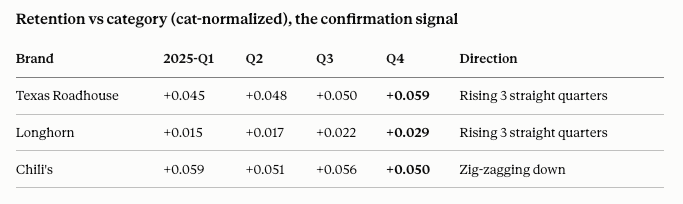
Chili's performed the strongest in Q4 in acquisition, but their retention vs category zig zagged and actually declined across the year. Their new customers didn't convert into a durable base. Chili’s is doing its job of attracting new customers but the steak deal is consistently keeping customers coming back.
Undoing Its Own Playbook
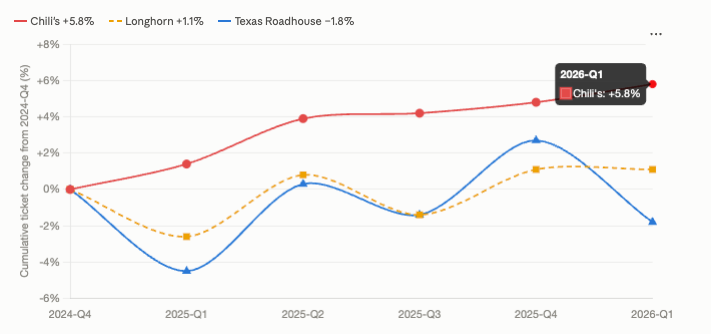
The turnaround was built on a fixed $10.99 value anchor. The panel shows Chili’s ticket up 5.8% across five straight quarters while the steakhouses, already premium, held flat and priced below inflation. Last Sunday - we took our family of six to Chili’s instead of our typical Chipotle run - instead of being comparable to Chipotle, the price was nearly the same as what we would spend on a big night out at Texas Roadhouse. Chili's used to sit next to Chipotle on my receipt, and now it is sitting closer to a steakhouse, without good steak.
Compounding - Not Theft
The press is plotting this as "Roadhouse vs. Chili's," but our data doesn't back that up. Our share of wallet analysis shows the steakhouses aren't raiding Chili's tables. They're pulling dollars out of the grocery aisle, the same way Chili's is pulling dollars straight from Chipotle. Each brand is winning in its own lane, and right now the steak lane is proving the most durable.
The main problem I see is Chili’s trained customers to expect a fast-food comparable ticket size with the $10.99 menu, and now those ticket sizes are rising back up into fast casual territory. The magic that drove the comeback is fading - and you can see it in the retention numbers before you see it in market share.
Coverage
Chili’s growth plans are painfully patient. Where Texas Roadhouse, Olive Garden, and Longhorn are expanding their footprint ~ 30 locations per year, Chili’s is putting all their focus on same store sales with their new remodeling strategy.
They are currently testing 4 concepts in the Dallas area inspired by a retro margarita bar feel that goes back to the brand’s roots. They’ve flagged 200 older locations for remodeling and targeting 10 in 2026 and up to 80 in 2027. They intend to restart new unit growth in 2028.
I can understand why Chili’s would go this route - mainly they have less to gain. With almost half the Average Unit Volume of a Texas Roadhouse, I expect Kevin Hochman wants to get his AUV up as high as possible before hitting the gas.
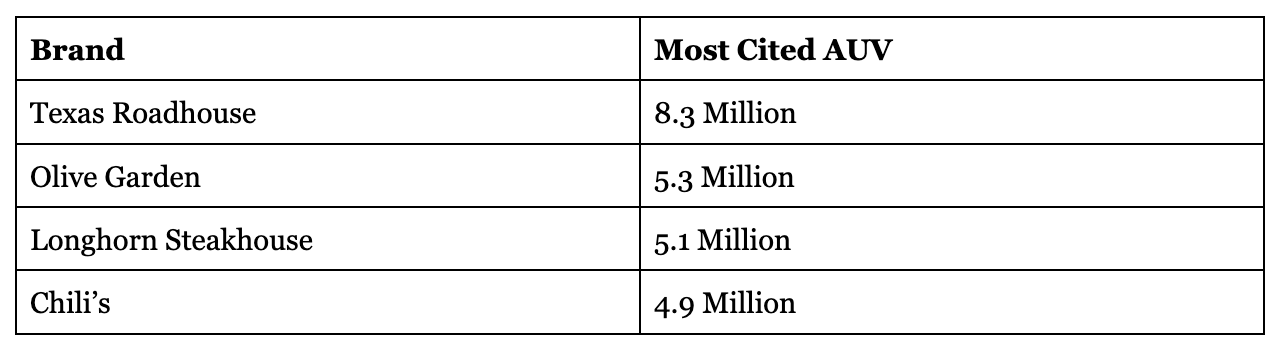
One thing we cannot see in our data is the cost side of the equation. We have to rely on earnings calls for that. So this could be the right call, and Hochman has a great track record. But I would not expect the same growth in market share from Chili’s over the next three years. In fact, barring bankruptcies in the category I’d expect them to be passed by Longhorn and even potentially Applebees who has at least 50 planned openings in the time period.
The reason they are holding off is their “North Of Six” initiative - which studies top performing Chili’s with AUV surpassing $6 million. Why pay for boxes if you think your current box could support a third more customers? Once they finish their re-imaging campaigns it will take another 18 - 24 months for new stores to be built. Landing most of their expansion potential in 2029. Meanwhile this gives the steakhouses a 3 year head start. That seems to be the bet Chili’s is willing to make.
Even with no new stores mapping QOQ market share changes, losing share in only three states and even then less than a point.
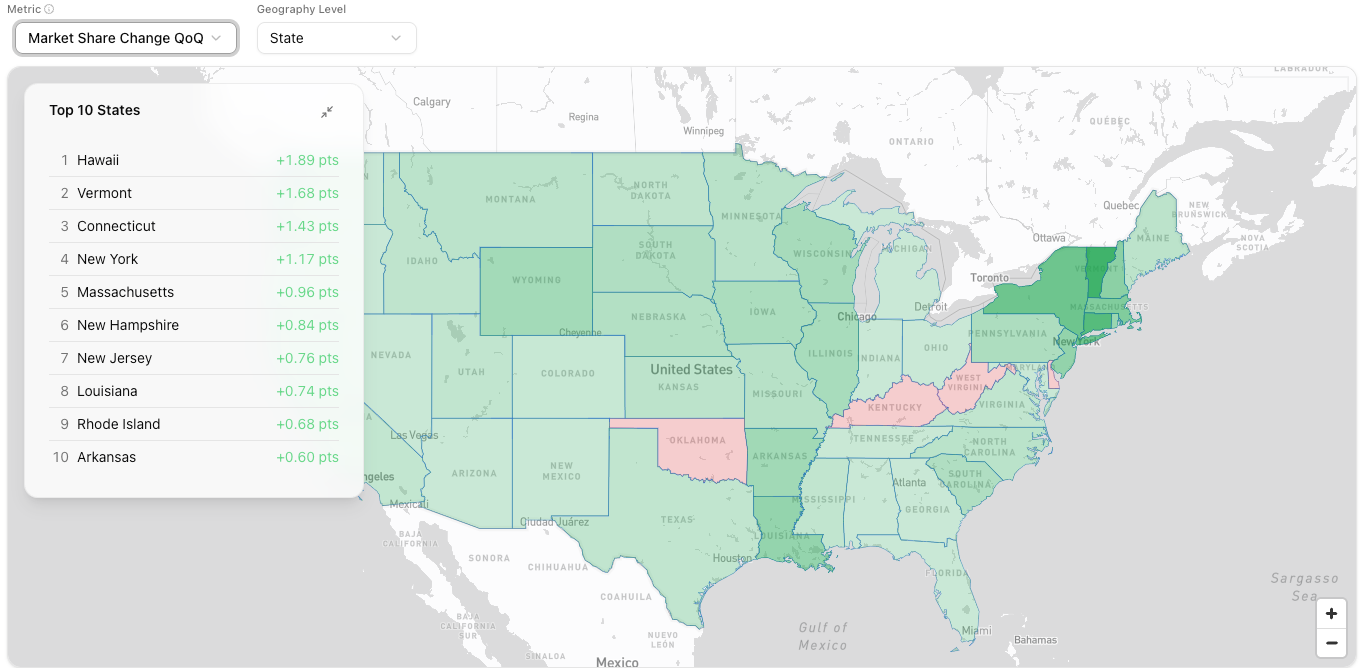
Chili’s is going to have to make up the gap in same store sales. So advertising is going to have to play a major role. Hochman and his handpicked CMO George Felix were the same guys who brought you the "Smell Like a Man" Old Spice relaunch and KFC's "Return of Colonel Sanders" - so yeah, I’d say this might be the team to do it. Let’s dig into their marketing approach.
Campaigns
The buzz around Chili’s turn around is real - twenty straight quarters of same store sales growth. They anchored on the $10.99 3-for-me, switching the competitive frame against Applebee’s and TGI toward fast food. In the process they increased the marketing budget from 32m (FY 2022) to 137m (FY 2025).
It’s important to remember the sequence the Hochman used. By first fixing operations, Chili’s was in a position where staffing, quality, and speed could “catch” the demand. Then comes the genius of George Felix. I see two things that he did that are world class:
He named the enemy out loud. Felix argued that fast food had “broken its promise” to consumers by letting prices creep to sit down levels. Then he hammered the point literally and quantitatively. The Big Smasher had “twice the beef of a Big Mac.” The comparisons made expensive fast food the villain and triggered every consumer's desire to win a great deal in a tough economy.
He built for speed. When the cheese pull went viral, most brands would have spent a month in meetings. Felix's team immediately dropped the Nashville Hot Mozz secret menu item and redirected paid creators to amplify the trend. You cannot manufacture a viral moment. You can decide in advance how fast you are allowed to react to one.
Campaigns And Their Impact
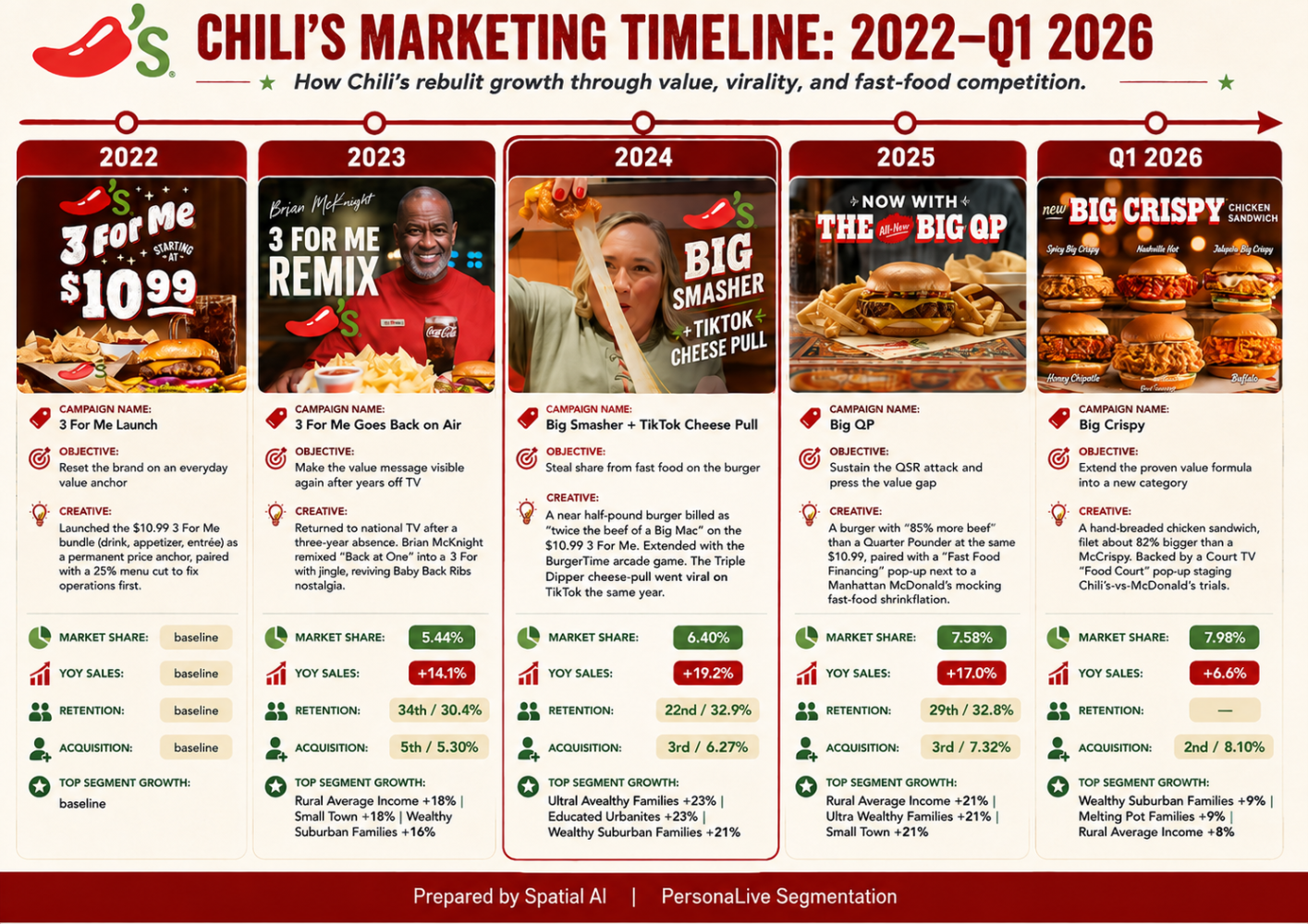
The Campaigns, Year by Year, and What Segments Grew Alongside Them
2022: 3 For Me Launch (the baseline). The turnaround began with Chili's relaunch of the $10.99 3 For Me as a permanent anchor and cut a quarter of the menu to fix the kitchen behind it. Marketing spend is at its $32 million trough, very little advertising to move any single group.
2023: 3 For Me Goes Back on Air. Chili's returned to national television after a three-year absence, using the Brian McKnight (Back At One) jingle to hammer the value message. The segments that grew fastest that year were Rural Average Income (+18%), Small Town (+18%), and Wealthy Suburban Families (+16%). This is pretty clear - Rural Average Income consumers are the most reachable with mass TV, Wealthy Suburban Families were stretching their dollar. At this point you see them going for Millennial nostalgia here rather than the focus on Gen Z.
2024: Big Smasher. The fast-food attack went overt, "twice the beef of a Big Mac," and the Triple Dipper cheese-pull went viral on TikTok the same year. The fastest-growing segments were Ultra Wealthy Families (+23%), Educated Urbanites (+23%), and Wealthy Suburban Families (+21%). A value-and-virality year did not primarily lift the budget-conscious, it lifted the affluent. A fair read: the TikTok explosion pulled in younger, higher-income, urban and suburban diners who responded to cultural relevance. The cheese-pull made Chili's cool again for people who had written it off.
2025: Big QP. Chili's pressed the McDonald's comparison harder with "85% more beef" than a Quarter Pounder. The top movers were Rural Average Income (+21%), Ultra Wealthy Families (+21%), and Small Town (+21%). What's striking is the breadth: both ends of the spectrum grew at the same rate, heartland and affluent together.
Q1 2026: Big Crispy. The chicken sandwich extended the value formula into a new category. The fastest Q1 movers were Wealthy Suburban Families (+9%), Melting Pot Families (+9%), and Rural Average Income (+8%). The mix is notable: Melting Pot Families, a Hispanic segment that we often see buying from places like Raising Cane’s and El Pollo Loco.
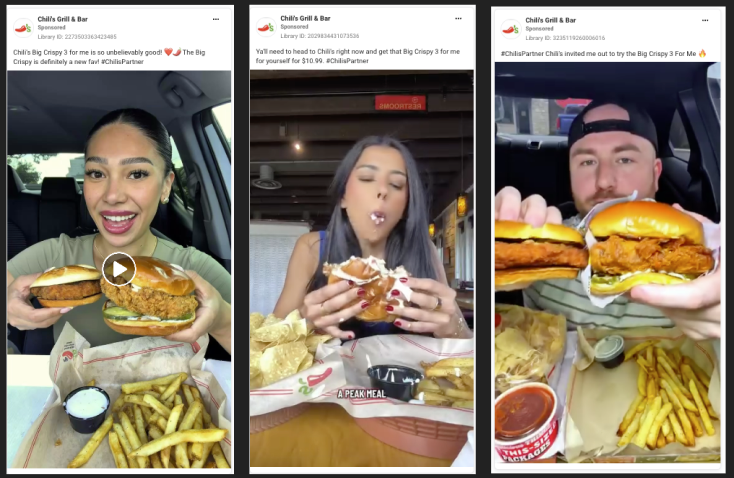
Paid Social Strategy: Chili’s has not been particularly loud on paid social until recently with the release of the Big Crispy. In these ads Chili’s is supplying micro-influencers with a script showing the big crispy vs. McDonald’s Chicken sandwich. The ads are overt - to the point - and provide a strong comparison.
Conclusion
Insights
Four years ago Chili's was invisible, over-complicated, and losing traffic. Hochman ran a disciplined sequence and turned it into the loudest comeback in the industry: costs funded experience, experience earned demand, and demand bought the biggest megaphone in casual dining. Then the culture showed up, and the operation was ready to catch it.
At Spatial we are analyzing what moves matter for taking market share. Internally we call the project “Brand Olympics”. I am looking for patterns in winners across 72 different retail categories. Here are the trends I see with Chili’s that are broadly applicable across retail.
Sequencing = Success: Hochman’s brilliant move was sequencing the comeback by reducing menu, streamlining operations, and cutting cost. Then re-investing that money afterwards. It is almost like he patched up the sails so that if a tailwind came it would catch Chili’s sales.
Calling Out The Enemy: Hochman and Felix bet on an enemy - “fast food is getting too expensive” - and were extremely overt in proving they can help you beat that enemy.
Value-premium and Flexing To Economic Conditions:Winning brands are not the cheapest or most expensive. They deliver the strongest value for the price, and today’s consumers quickly recognize a bad deal.
When life gives you virality - act fast: Chili’s couldn’t manufacture the viral Tiktok cheese pull. But their moves after it extended its lifespan. They quickly dropped a secret menu and redirected paid creators to amplify the trend.
Taking Share Beyond the Category: In a crowded or stagnant category, growth can come from targeting an adjacent one. But the move needs a powerful consumer insight—like “fast food is getting too expensive”—and unit economics that can deliver on it.
Don’t let your value proposition creep: Chili’s is sticking to their $10.99 strategy - but if you order outside that menu it starts getting expensive real fast. If you are going to put your stake in the ground - don’t stray far from it.
The Future
I am cautiously optimistic about Chili’s. They are taking the long run approach by getting their store sales “north of six”. It is going to cost them short term market share, but it rhymes with Hochman’s theme of sequencing fundamentals first before scaling.
If they can keep their prices down, and re-open their renovated stores with some segment specific target marketing I think they have the chance to maintain their position in the top three over the next two years and set themselves up for some major growth by 2028.
They’ll have to work tightly with the real estate team to get that done. Two moves compound: renovating the right stores in the right markets, filled faster by the right customers, driving the margin Chili's needs to hit north of six million on those units.
The first sequence made Chili's mythical. The second one decides whether the myth becomes a dynasty. And if there is one thing this teardown proves, it is that the man running the place knows better than anyone: the order is the strategy.
What you should do now
Whenever you're ready, here are 3 ways Spatial.ai can help:
- See PersonaLive In Action. If you'd like to segment and target your best customers using real-time behavioral data, schedule a free 30-min demo to get started.
- Subscribe To Consumer Code. If you've found this helpful, check out our newsletter and podcast where we share more consumer research and insights for retail marketers.
- Share This Post. If you know another marketer who’d enjoy reading this post, share it with them on Linkedin, X, or Facebook.
Get retail marketing tips
We email every monday with smart growth strategy ideas. Almost no promotion. Just value.
.avif)
%20(1).jpg)