LongHorn Teardown: The Data the Media Missed


We set out to tear down Texas Roadhouse's growth. Then LongHorn grew 14% in Q1 2026, beating Chili's and Texas Roadhouse in a category that grew 0.2%. The media had an easy answer: record beef prices. So we analyzed every Darden earnings call, menu prices back to 2019, USDA herd data, and billions of credit card transactions through the PersonaLive platform.
Beef explains why the door opened. It does not explain why LongHorn was the one standing in it. No one is talking about the unique way grew between Q1 2025 & Q1 2026:
- 105 days between average visits, against 120 at Texas Roadhouse and Outback
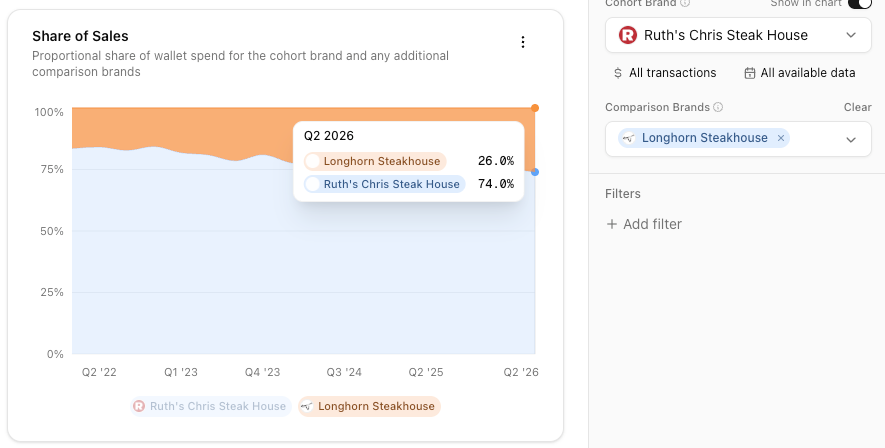
- + 16 points of share of Ruth's Chris customers' wallets since 2022
- + 27% growth from households under $50,000 year over year
- + 25% growth from households over $500,000 year over year
LongHorn is growing at both ends of the income ladder at once, and getting every one of those customers back through the door 15 days sooner than anyone else in the category. Three threads run through this teardown:
The two price points. Grocery steak hit $13.02 a pound. LongHorn's ribeye dinner runs under $30. The family grilling at home and the family in the booth are the same family. Darden’s scale helps them lock in beef prices.
The undivided pipeline. LongHorn opens 25 to 30 steakhouses a year, one concept, all steak - focused. Texas Roadhouse is putting a record $400 million into three concepts and pressing the gas on a sports bar. Outback is closing.
The exposure. LongHorn's base skews old and lower income. Those are the households with the least room left. The same tilt that powered the breakout is the thing that breaks it.
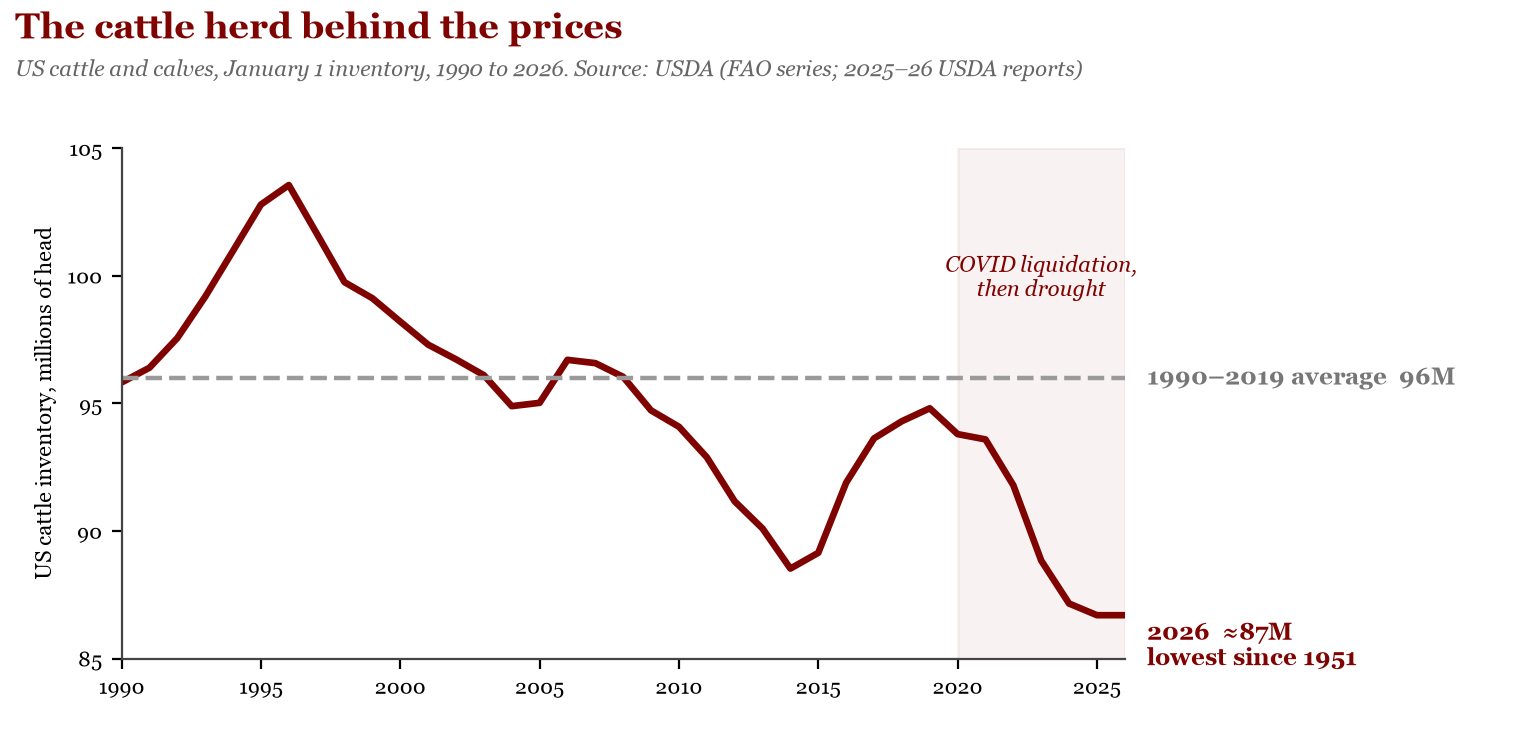
But is this a strategy or a windfall? The herd is the smallest since 1951 and beef stays expensive into 2027. What happens when it doesn't? Is LongHorn compounding, or just standing in the right place at the right time?
Get the data that powered this teardown here.
Let's dig in.
Case
Middle America's steakhouse, at the moment it broke out
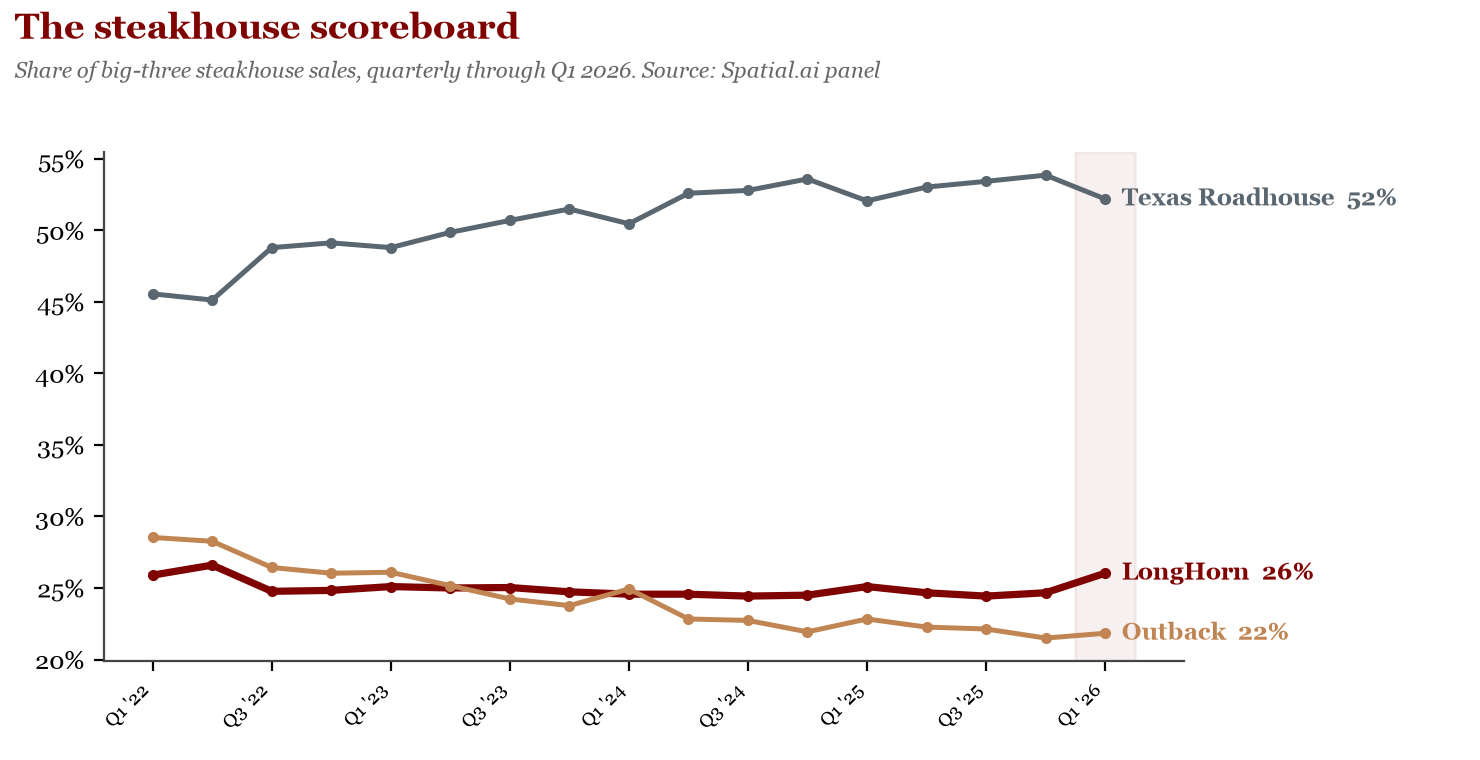
America's casual steakhouse business is dominated by three chains: Texas Roadhouse, Outback Steakhouse, and LongHorn. LongHorn Steakhouse stayed steady each quarter until a breakout Q1 2026 where they saw 15% YOY sales. Below we examine the market climate and strategies that led to this breakout.
Built to compound
LongHorn focuses on steak, first and last: no themes, no bar scene. Premium hand-cut steak, that's it. That focus shows up as the brand's defining statistic. Its guests return every 105 days, against roughly 120 at Texas Roadhouse and Outback. Fifteen days is the difference between three and a half visits a year and three, roughly 15% more visits from the same guest before anyone new walks in.
That return rate is what makes new customers so valuable to LongHorn, and it is the mechanism of the breakout. A new guest won by LongHorn comes back sooner and more often than the same guest won by a rival. Each addition to the customer base generates more revenue at LongHorn than it would at its competitors.
LongHorn is still building. It operates 618 restaurants, fewer than Texas Roadhouse's 687 or Outback's 660, and Darden is opening new LongHorns at a pace of 25 to 30 a year. Texas Roadhouse is opening 20 - 25. Outback is closing restaurants. Texas Roadhouse still opens steakhouses, but a growing share of its development budget now goes to its sports-bar and fast-casual concepts rather than to steak. Among the three, LongHorn is the only brand whose entire pipeline is focused on what it was built to do: be a steakhouse.
From a snowstorm to Darden
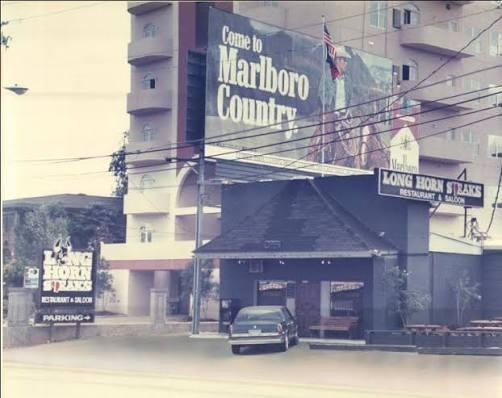
LongHorn opened on August 10, 1981, on Peachtree Street in Atlanta, a single Western-themed steakhouse founded by George McKerrow Jr. It nearly failed in its first winter until a January 1982 snowstorm shut the city's highways and filled the dining room with stranded drivers buying dollar drinks and cheap steaks, the week of word-of-mouth kept the doors open. The concept went public in 1992, acquired Bugaboo Creek and The Capital Grille in 1996, and renamed itself RARE Hospitality in 1997, with LongHorn as its original and largest brand. On October 1, 2007, Darden Restaurants acquired RARE for $1.27 billion, taking on 288 LongHorn locations and 29 Capital Grille locations, folding them into the largest full-service restaurant company in America.
Beef got expensive. And that was actually a good thing for Darden & Longhorn because of their scale and buying power. With their 2,200 restaurants they were able to lock in beef prices months ahead - so that when beef spiked, Darden was still paying the old price. Their margin in Q1 improved 1.2% while at the same time Texas Roadhouse was getting hit with 7% beef cost inflation - and Texas took that on the chin when they only increased menu prices 2%.
Steak, repriced
Beef is the largest meat category in the American grocery basket, and in 2026 it hit its highest recorded price: $13.02 a pound for grocery steak in April, up 67% from 2019. Wholesale beef rose about 75% over the same stretch, driven by a US cattle herd at its smallest in 75 years. LongHorn's menu did not follow the meat case up. The comparison is cleanest cut for cut. A pound of boneless sirloin at the grocery store went from about $8.50 in early 2019 to just over $14 in the first quarter of 2026, up 66%; LongHorn's Renegade Sirloin went from $11.99 to $17.49 over the same years, up 46%. The same pattern holds across the steak menu, with the 12-ounce ribeye up 44% since 2019 against the grocery store's 67% for steak overall.
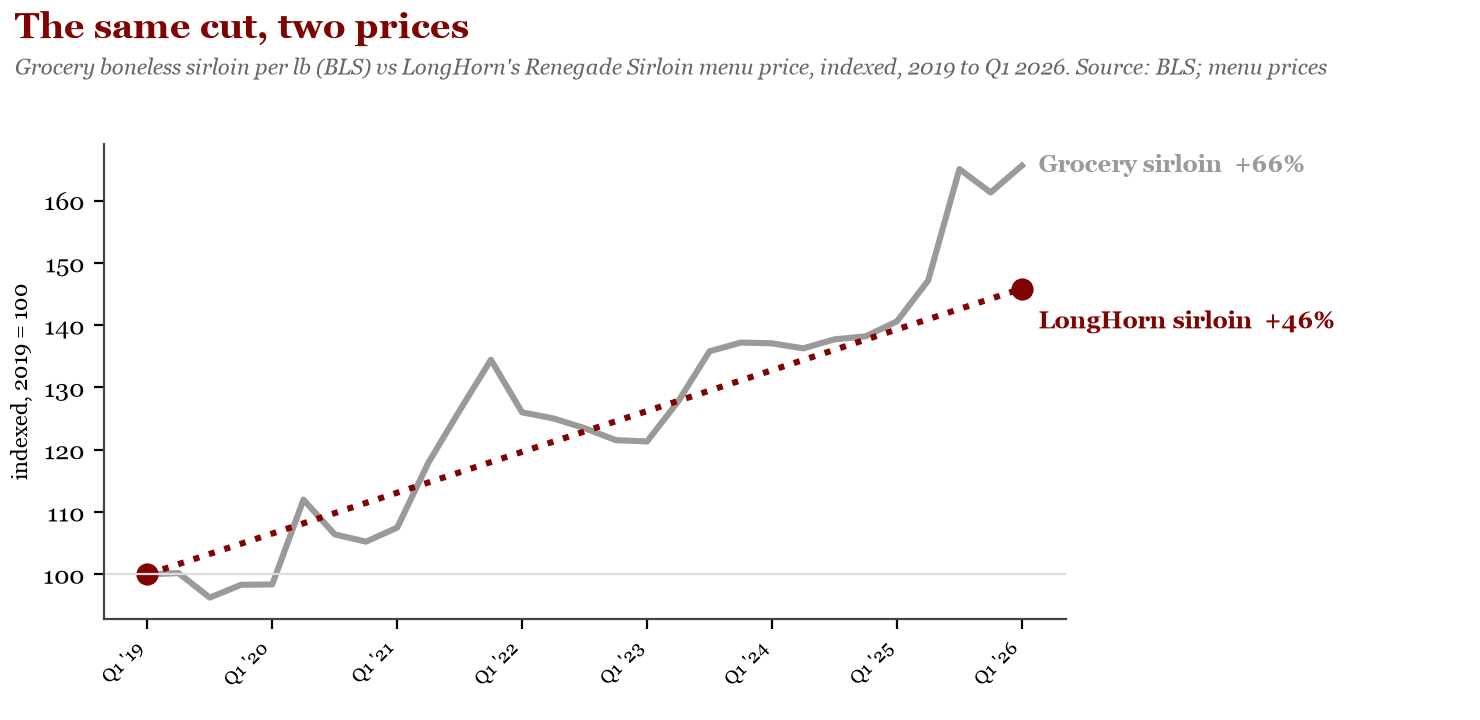
This is a value question for an increasingly value-conscious consumer. A pound of grocery ribeye costs about $13 before anyone seasons it, cooks it, serves it, or cleans up after it. LongHorn's full ribeye dinner with sides runs under $30.
In 2026 the US grocery shopper is under pressure. Every one of the two-to-three weekly grocery trips put the price of the home-cooked version in front of LongHorn's exact customer, and the gap between cooking a record-priced steak and having one cooked correctly kept narrowing.
Longhorn made specific choices to be standing in the value gap. It moved LongHorn's spending away from price promotions and into the food, and it priced below beef’s inflation on purpose. As Rick Cardenas, Darden's CEO, said in the company's Q4 fiscal 2026 earnings call, "it doesn't hurt that there's a high beef inflation in the market. And so the relative value looks a little bit better for LongHorn."
Category
Winning a category that stopped growing
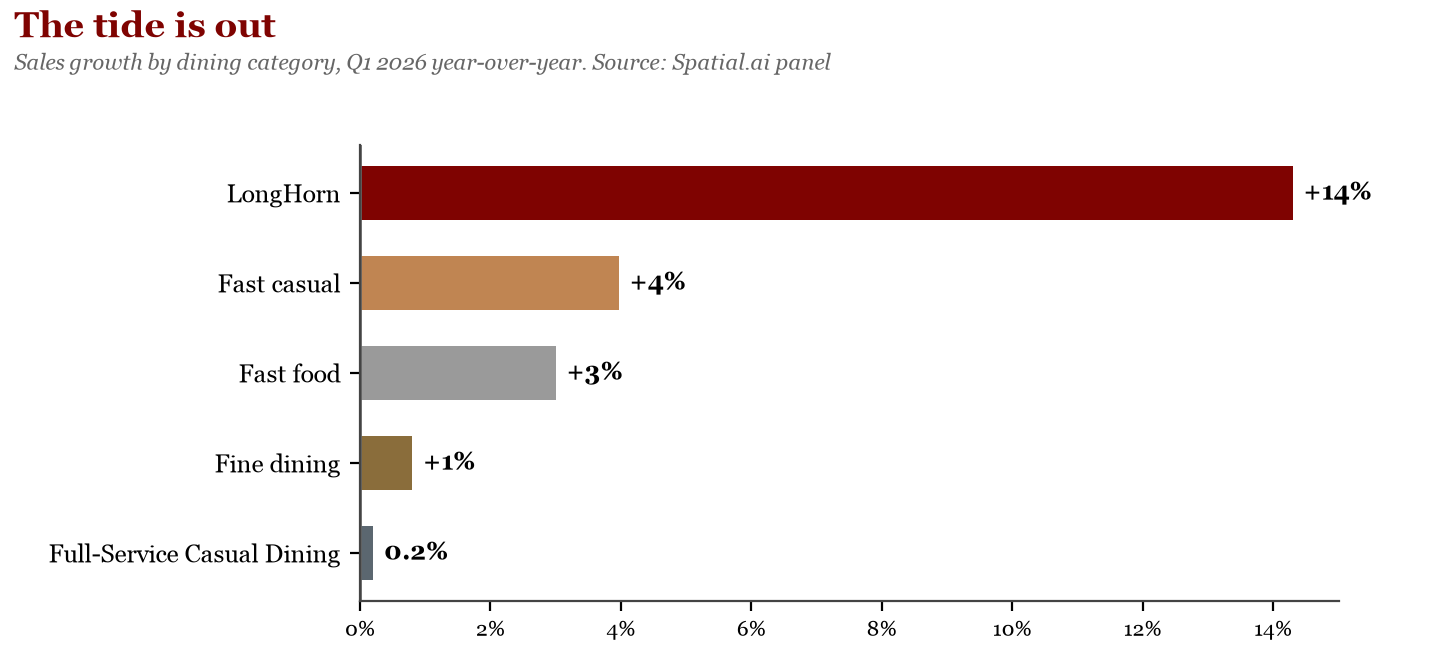
Overall restaurant spending grew by about 5% in the first quarter of 2026, but the growth was uneven. Fast casual grew 4%, fast food 3%, fine dining was roughly flat, and full-service casual dining, LongHorn's category, was flat too, up 0.2%. LongHorn grew 14%. It outgrew every category of American dining, and it did so inside the one category that had stopped growing altogether.
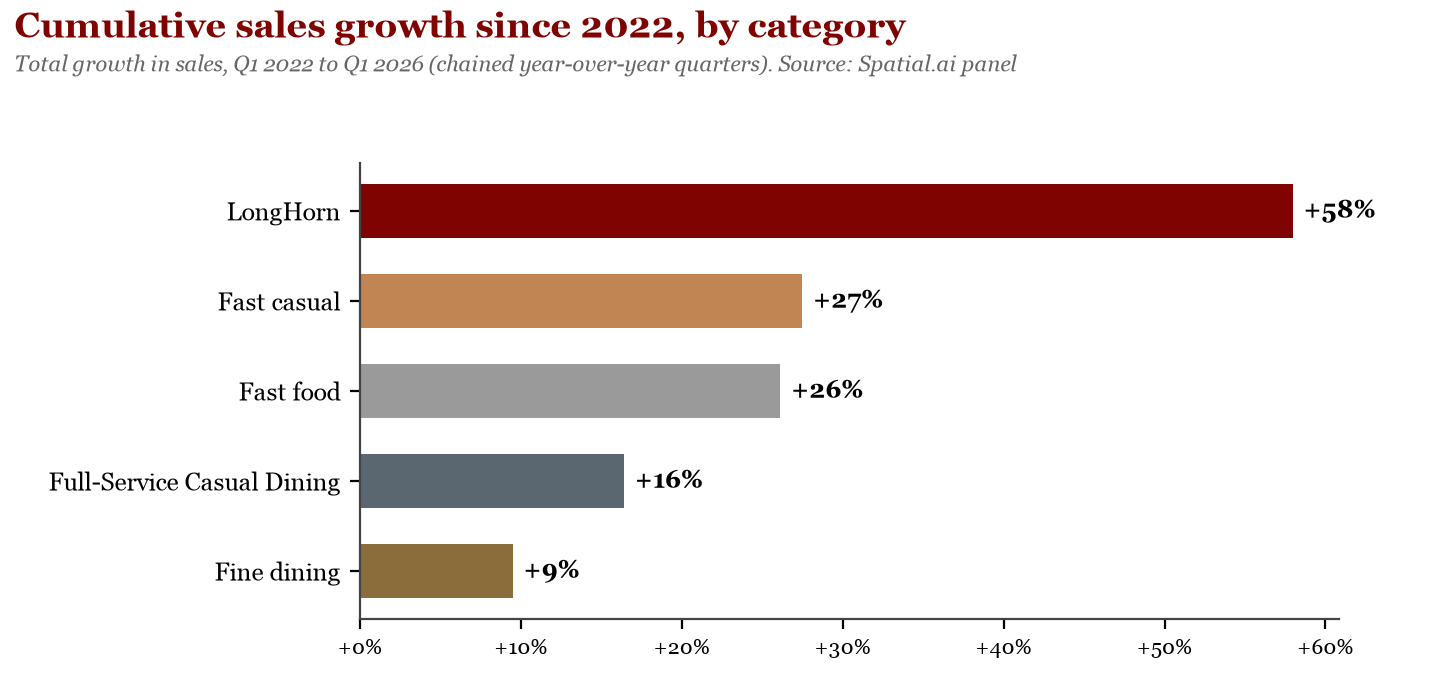
The four-year picture is the same story stretched out. Since 2022, LongHorn's sales are up 58%, more than double fast casual's 27% and fast food's 26%, and well clear of its own category's 16% and fine dining's 9%. Full-service casual dining's problem is structural: the category was losing traffic before 2026, the post-COVID recovery and price inflation masked the decline through 2023, and when inflation cooled the category flattened in 2024 and fell through 2025 before steadying in early 2026. LongHorn's is taking share from a pie that stopped expanding.
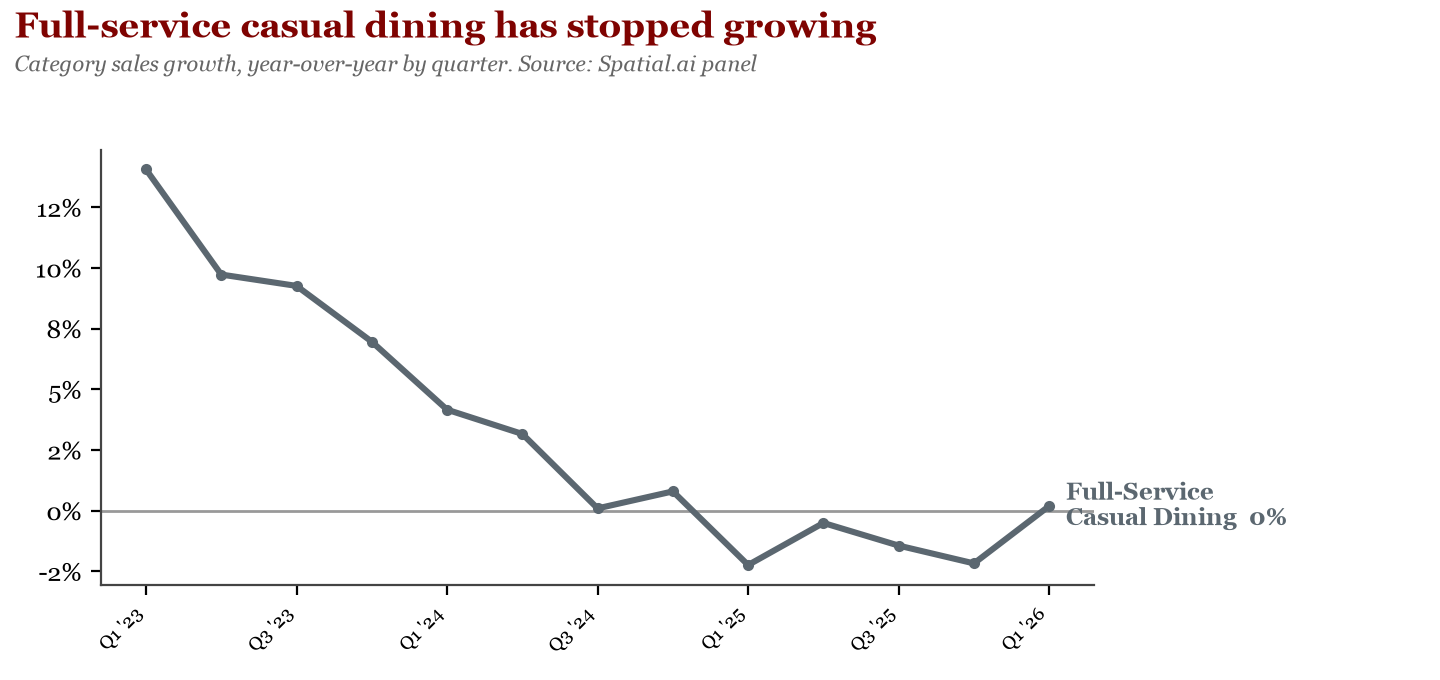
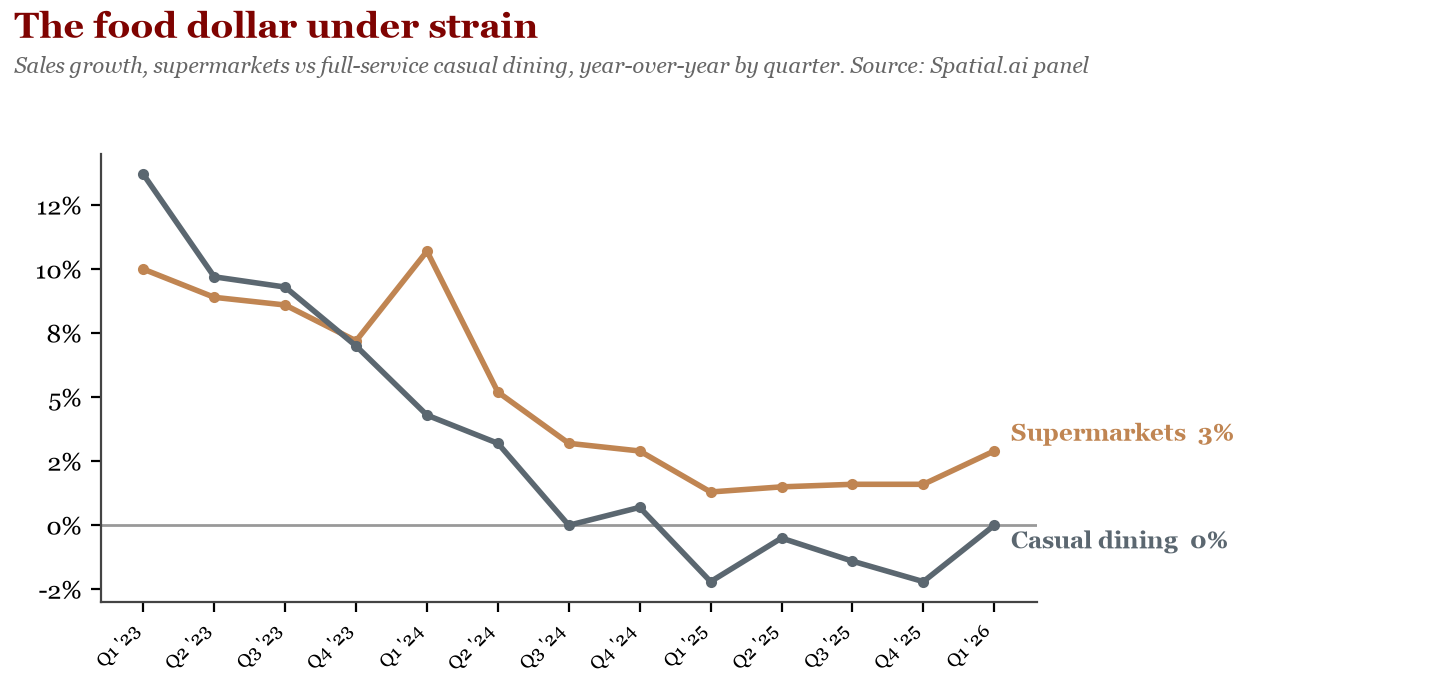
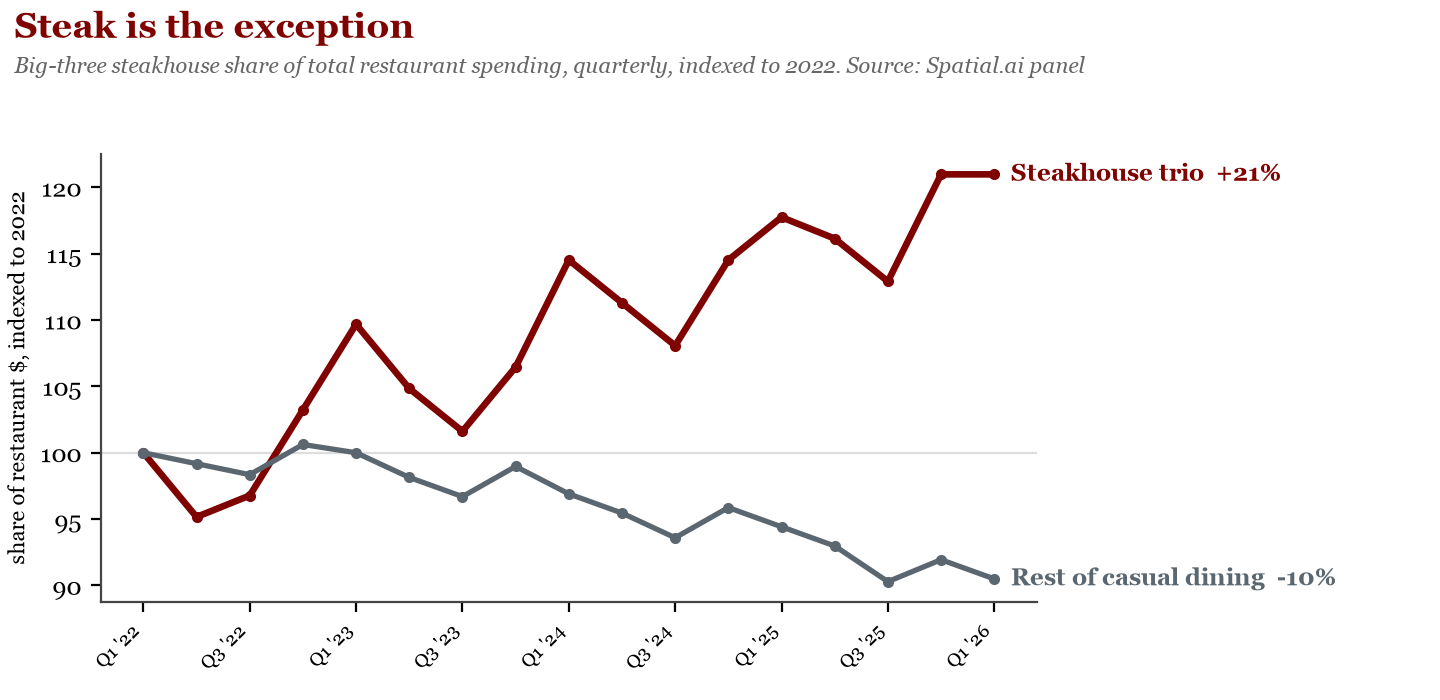
The consumer driving that decline shows up most clearly against the grocery store. Supermarket spending growth and full-service casual dining spending growth both fell through 2024 and 2025, with full-service casual dining falling further, into outright contraction, because dinner out is the easier line to cut when the grocery bill itself is inflating. Within that strained restaurant wallet, one pocket kept growing: the three big steakhouses' combined share of all restaurant spending is up more than 20% since 2022 while the rest of full-service casual dining's share fell about 10%. The customer cutting back on eating out was not cutting back on steak.
The breakout
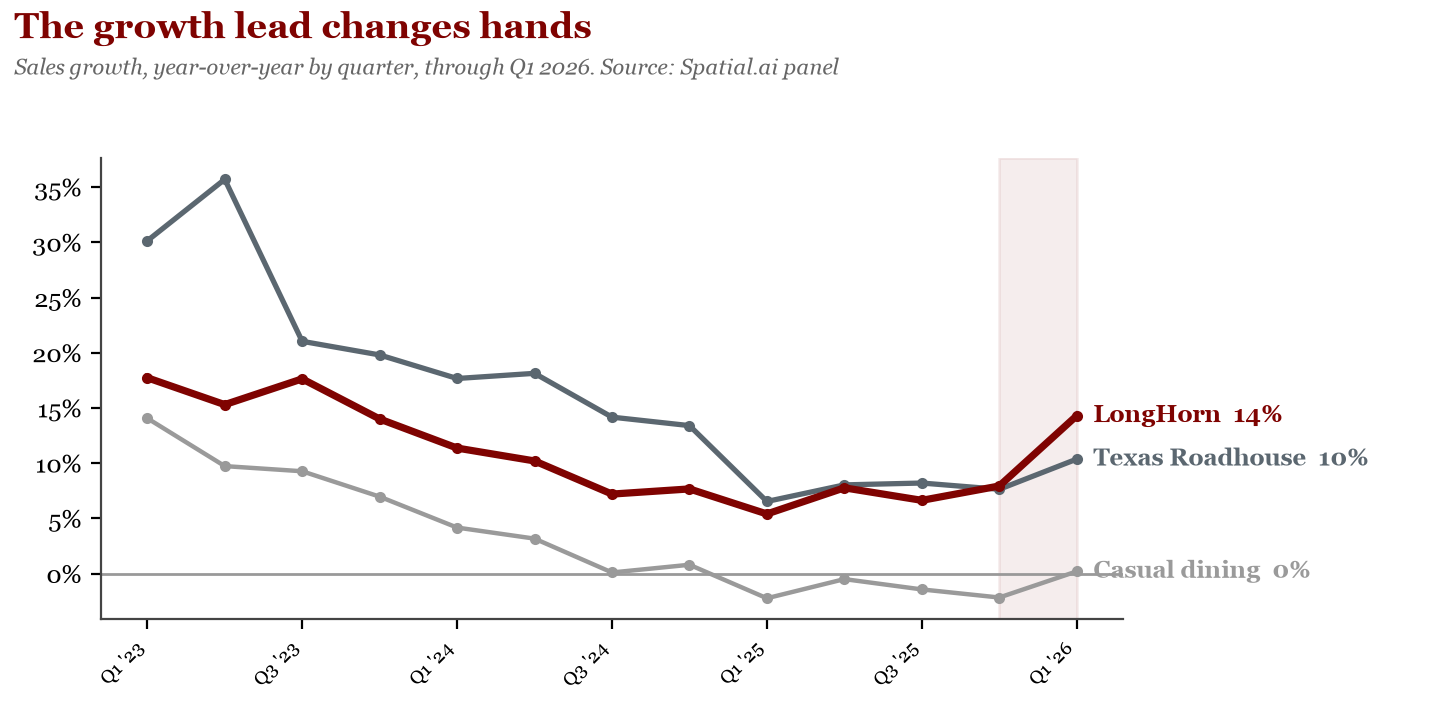
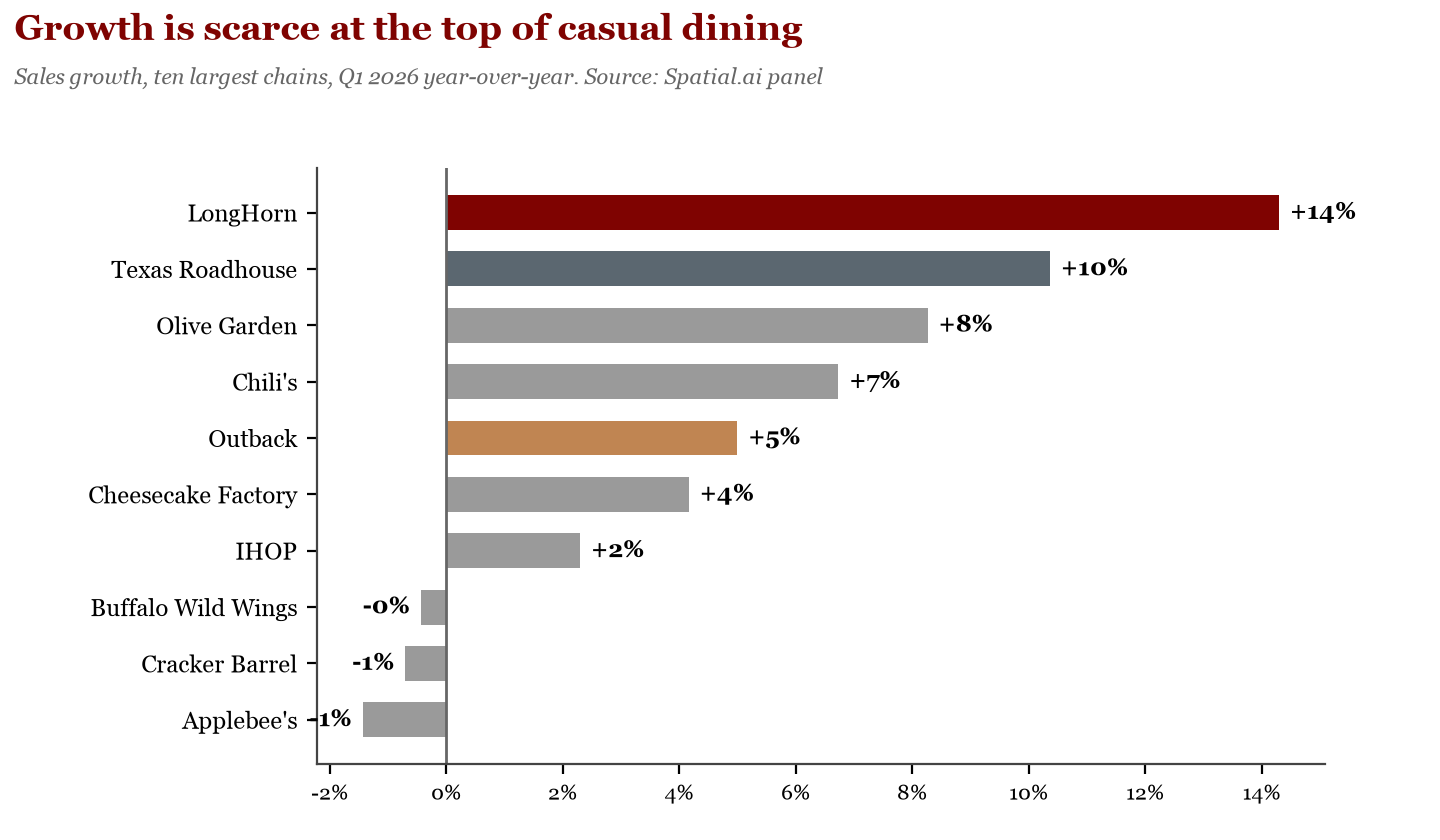
For most of the past four years, Texas Roadhouse was the category's growth leader, compounding at double-digit rates on the lowest prices in full-service dining while Outback shed guests. That order held into 2025. In the fourth quarter of 2025 the gap started closing, and in the first quarter of 2026 LongHorn passed Texas Roadhouse to take the highest growth rate among full-service casual dining's ten largest chains. The rest of the top ten shows how scarce growth is: Applebee's, Buffalo Wild Wings, and Cracker Barrel shrank outright in Q1, IHOP and Olive Garden grew modestly, and nothing else came close to LongHorn's 14%.
Stealing Steakhouse Share From The Category Above
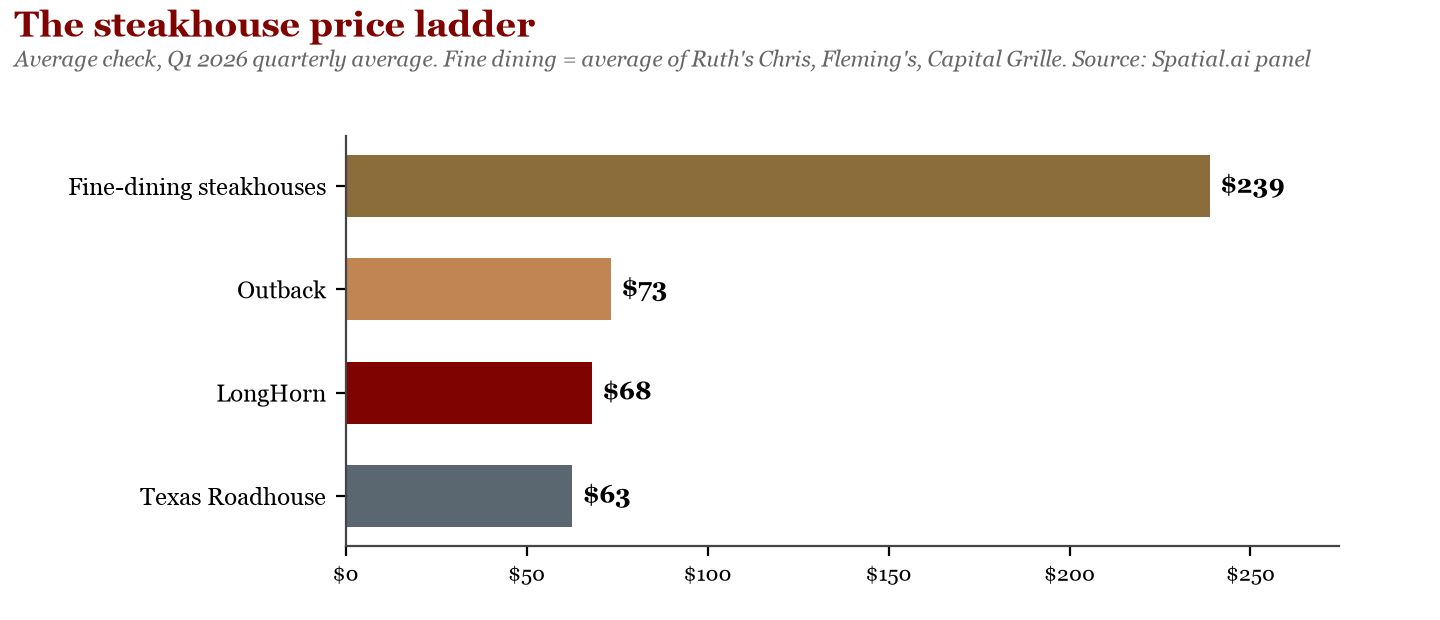
Fine-dining steakhouses spent 2025 as the weakest corner of the restaurant economy. Ruth's Chris, The Capital Grille, and Fleming's average a $239 check, compared with LongHorn's $68. Those fine-dining diners did not leave steak: instead they are trading down. Using a share of wallet analysis we can see Longhorn went from 10% of Ruth’s Chris dollars spent to now 26%.
The trade-down currently runs in one direction, from the $239 check to the $68 one, and LongHorn is positioned directly beneath the falling category.
Why beef stays expensive
The force underneath the whole category is the cattle supply. The US herd stands at roughly 87 million head, its smallest since 1951 and roughly nine million below its three-decade norm, and the slide traces directly to COVID. When restaurants and meatpacking plants shut in 2020, demand and processing capacity collapsed at the same time; cattle backed up on feedlots, prices paid to ranchers crashed, and since holding an animal costs money every day, ranchers culled deep, including the breeding stock that builds future herds. The drought and record feed costs that followed in 2021 and 2022 kept them selling instead of rebuilding. Rebuilding is slow by nature: ranchers rebuild by holding breeding stock back from slaughter, which cuts beef supply further before it adds anything, and the cycle from a retained animal to beef on a shelf takes years. Imports are not closing the gap either. The US placed a 50% tariff on Brazilian beef in 2025, and the expanded quota for Argentine imports that followed is small relative to US consumption. Grocery beef therefore stays historically expensive through at least 2027 on most forecasts, and every quarter it does, the price comparison the household runs between the meat case and the steakhouse keeps tilting the steakhouse's way. Among the big three, LongHorn is best positioned to benefit: Texas Roadhouse absorbs beef inflation in its margins while LongHorn's costs are hedged through Darden, and Outback's traffic is already falling while LongHorn's menu pricing stays under the grocery store's inflation. The category's hardest problem is LongHorn's clearest advantage.
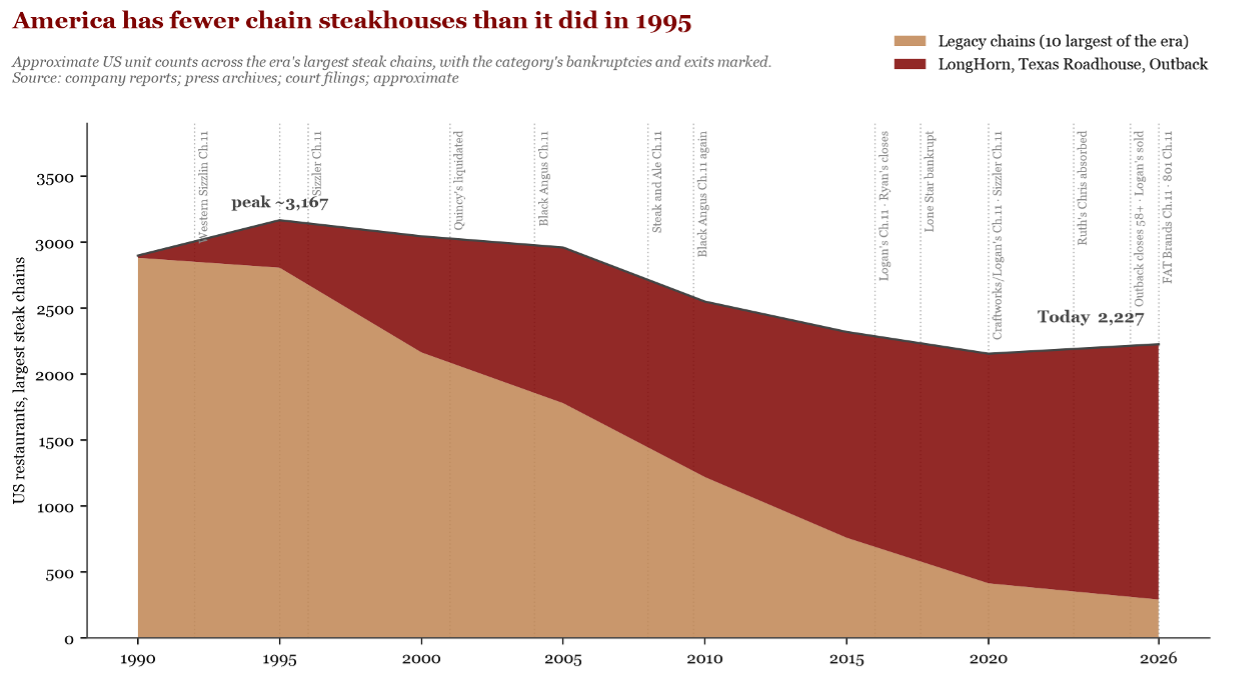
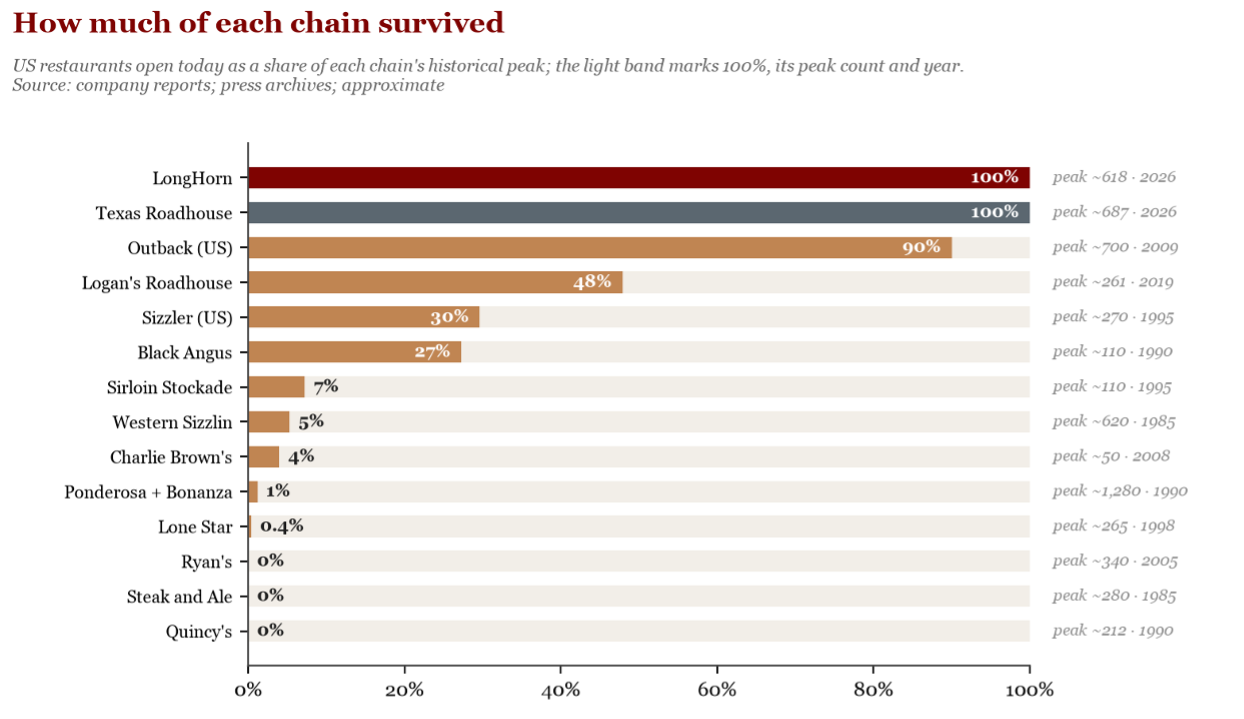
Destined to Fail: You might be thinking at this point “people are just buying more steak at restaurants and that is why Longhorn is winning”. Not true. In fact they have been losing for awhile. Steak carries a cultural significance in America that few foods can match, and LongHorn and Texas Roadhouse have harnessed that culture, but they have not succeeded because of it. Chain steakhouse counts peaked around 1995, near 3,200 restaurants across the era's largest chains, and have fallen ever since, to roughly 2,200 today. The three decades in between are a record of Chapter 11s, consolidations, and mass closures. Even the most famous name in American steak, Ruth's Chris, sold itself in 2023 for roughly its 2005 IPO price, eighteen years of cultural cachet converted into zero shareholder return. By all historical accounts, a steakhouse chain is a business destined to fail. LongHorn and Texas Roadhouse are the exceptions, and the exceptions share commonalities that have nothing to do with the beef: scale that lets them buy and hedge what smaller operators must absorb, and a long run of smart business decisions on price, value, and format. The pattern repeats down the list, where the healthiest of the remaining small chains, Saltgrass and The Capital Grille, are the two backed by giant parents in Landry's and Darden.
What the growth is made of
LongHorn's growth is guests, not prices. Darden reports LongHorn's menu-wide pricing, the average increase across its entire menu, at roughly 4% for fiscal 2026, while its sales grew 14%. Company disclosures put LongHorn's traffic several hundred basis points ahead of the casual-dining industry. Guests walking in more often, at modest pricing, in a flat category, is share being taken and kept.
Customers
Demographics & Geography
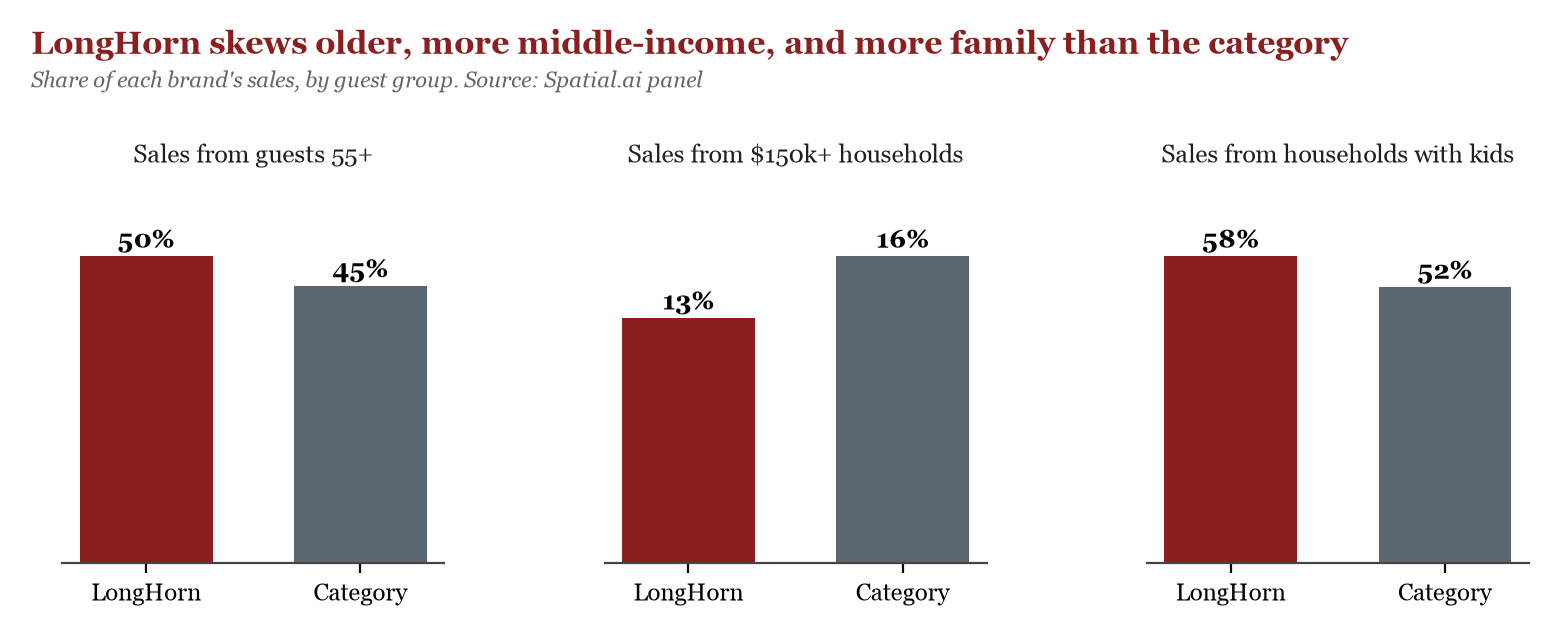
LongHorn's customers are older, more middle-income, and more likely to be families than the casual dining average. By customer group, its revenue leans hardest on the rural South, Appalachia, and Midwest.
Psychographic Segments
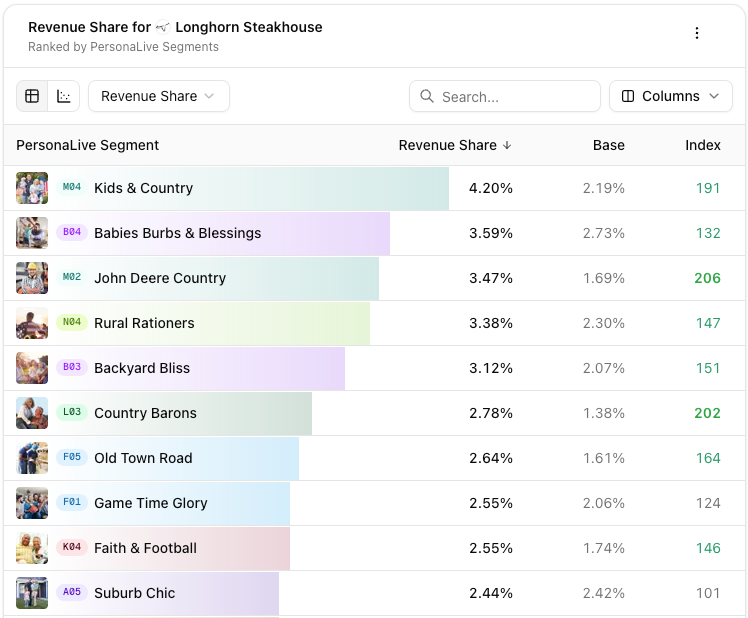
In absolute revenue share rural & middle income suburban segments drive Longhorn’s revenue share.
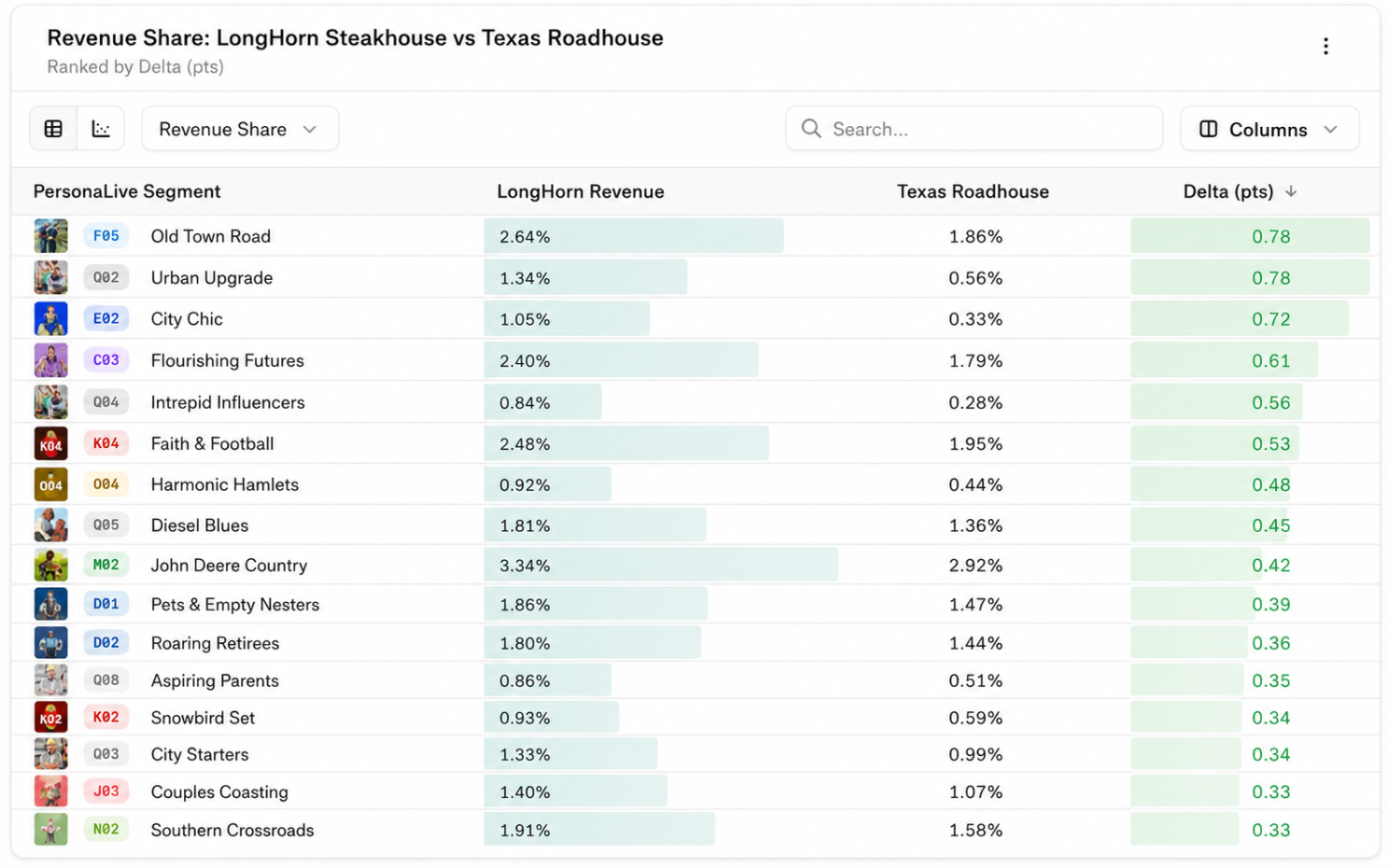
What I found most interesting is comparing their segments to Texas Roadhouse and looking at the delta. Ranking by the delta in revenue share of Longhorn Vs. Texas - you can see Longhorn winning the outer ring of cities and Texas winning the far rural crowd. Uniquely, Longhorn is doing especially good with segments that have a higher percentage of African Americans.
Who pays LongHorn's bills. Source: Spatial.ai panel.
The beef overlap
That customer profile matters because two maps overlap on it. The first is appetite. USDA data shows rural households eat about 75 pounds of beef per person a year. In cities it's 63. The Midwest and South lead the coasts. But appetite alone points to the Plains, and LongHorn sits further south and east. Income completes the picture. Mississippi, Louisiana, West Virginia, Kentucky, Arkansas, and Alabama eat a lot of beef and also rank among the lowest-income states in the country. Those households eat more of their beef at home, so record meat case prices hit them hardest. Put the two maps together and you get a band running from the South up through Appalachia. That is exactly where LongHorn's restaurants are.
The family grilling steak at home and the family in a LongHorn booth are the same family at two price points. That's why record grocery prices moved spending between the two instead of away from beef. And why it moved to LongHorn first.
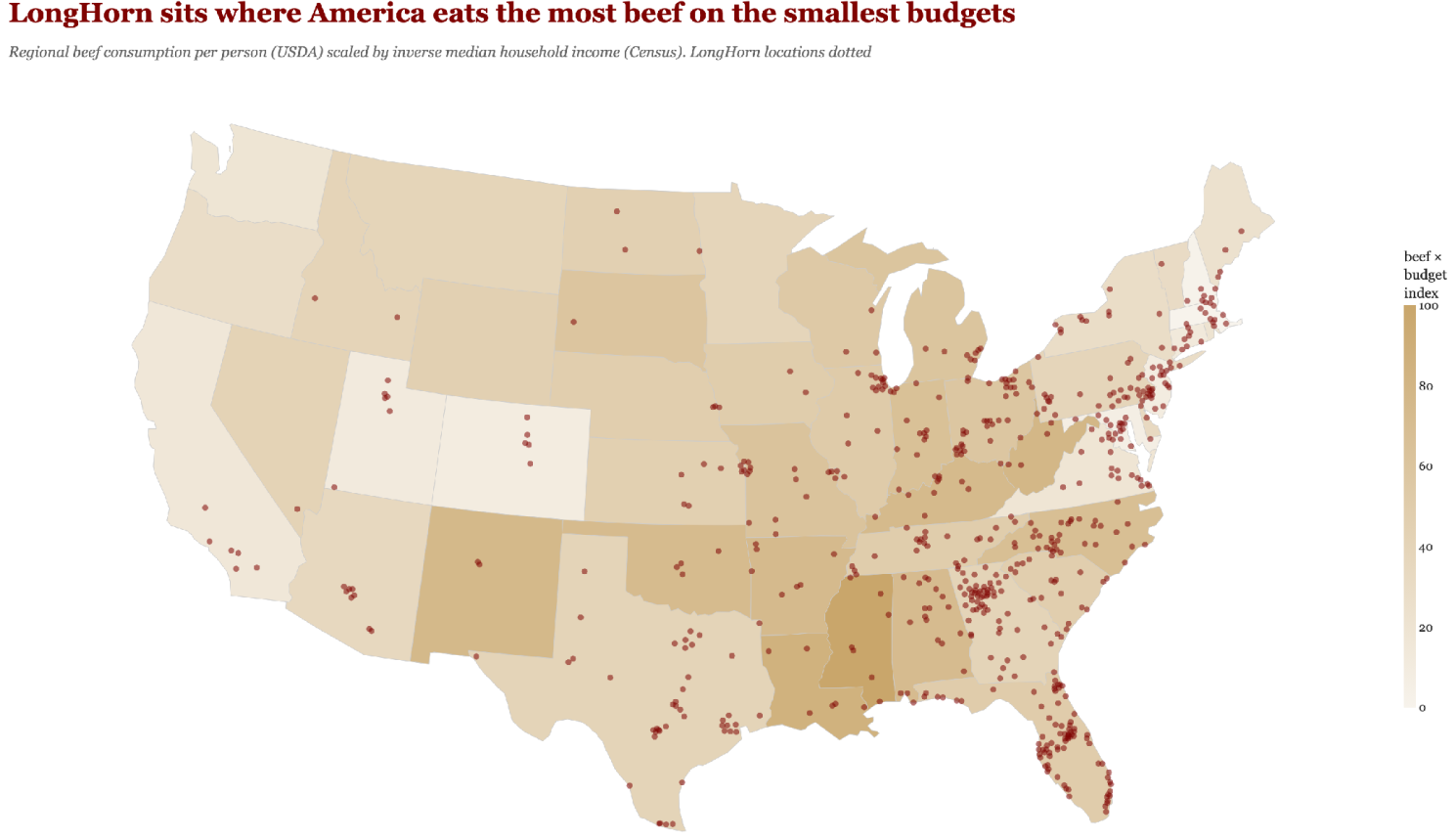
LongHorn sits where America eats the most beef on the smallest budgets. Source: USDA; Census; brand locator.
The base widened as the pressure built
LongHorn's customer mix shifted steadily across the four years of grocery inflation, and the direction of the shift tracks the pressure. The groups gaining the most share of LongHorn's sales since 2022 are its lower-income, small-town, and striving-urban households, while the comfortable suburbs and retirees ceded share. Every group grew in absolute dollars; the pressured groups simply grew fastest, which is what a value migration looks like from inside a brand's own books. The income cut says it plainly: every band under $50,000 gained share of LongHorn's sales over the period, and the under-$20,000 band gained the most.
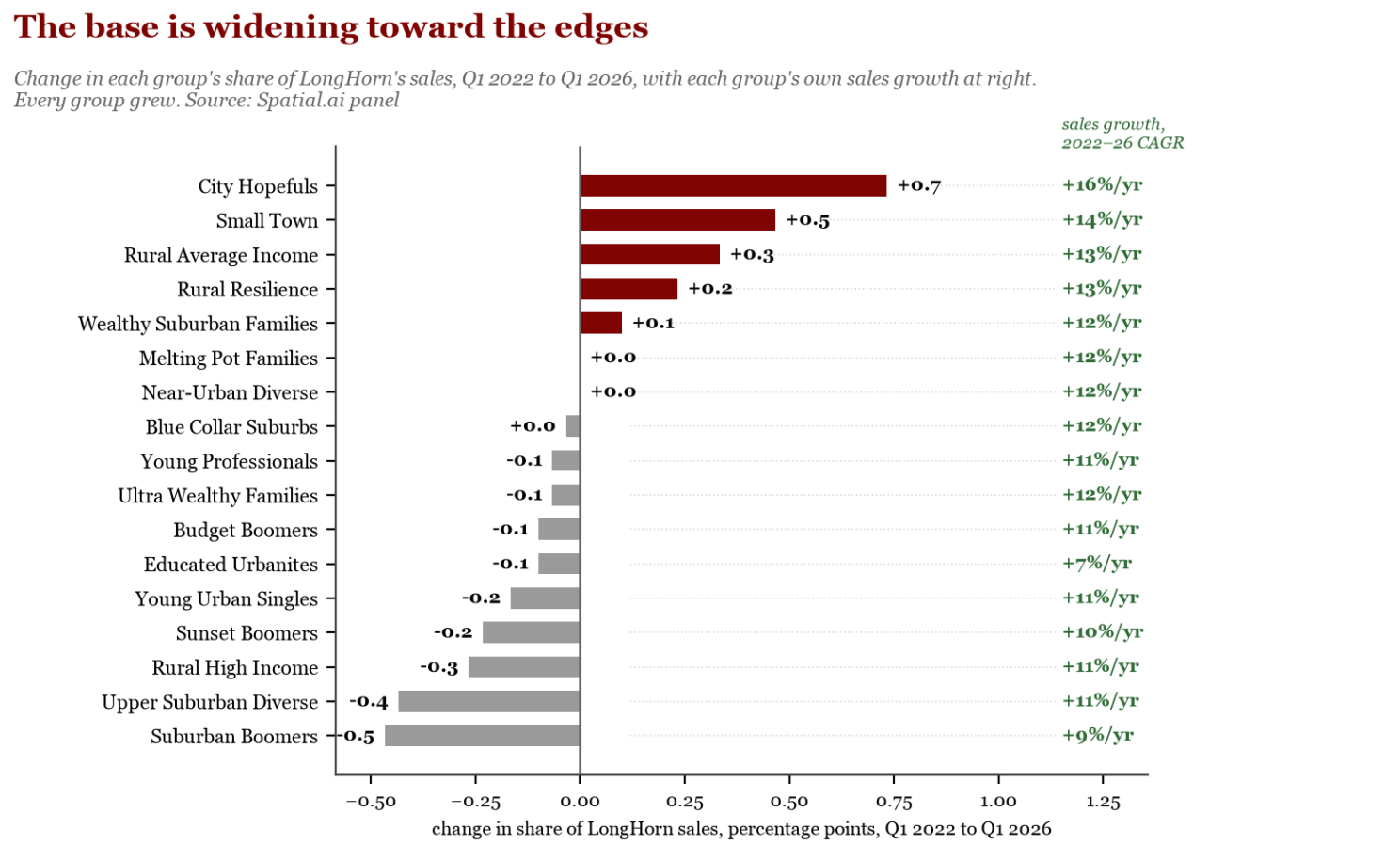
The base is widening toward the edges. Source: Spatial.ai panel.
Growth at both ends
The first quarter of 2026 sharpened that migration into a barbell. LongHorn's fastest-growing income bands were the two ends of the distribution, the under-$20,000 households up 36% and the $500,000-plus households up 25%, with the middle growing solidly between. Both ends are value decisions. The bottom is trading up from the grocery store to the steakhouse that beats the meat case's price; the top is trading down from the $239 fine-dining check to the $68 one that serves the same cut. The bottom is also the far larger population, which makes it the bigger driver of the quarter. Neither group is settling. Both are maximizing what a steak dollar buys, and LongHorn is currently the answer to that question from either direction. Darden's own read of the quarter matches: Cardenas reported visit growth "from all income groups, including the bottom quintile" on the Q4 fiscal 2026 call. The rivals' calls describe the same migration from the losing side: Texas Roadhouse's CFO noted guests shifting to lower-priced cuts within its menu, and Bloomin' reported Outback's first-quarter traffic down 2.4%.
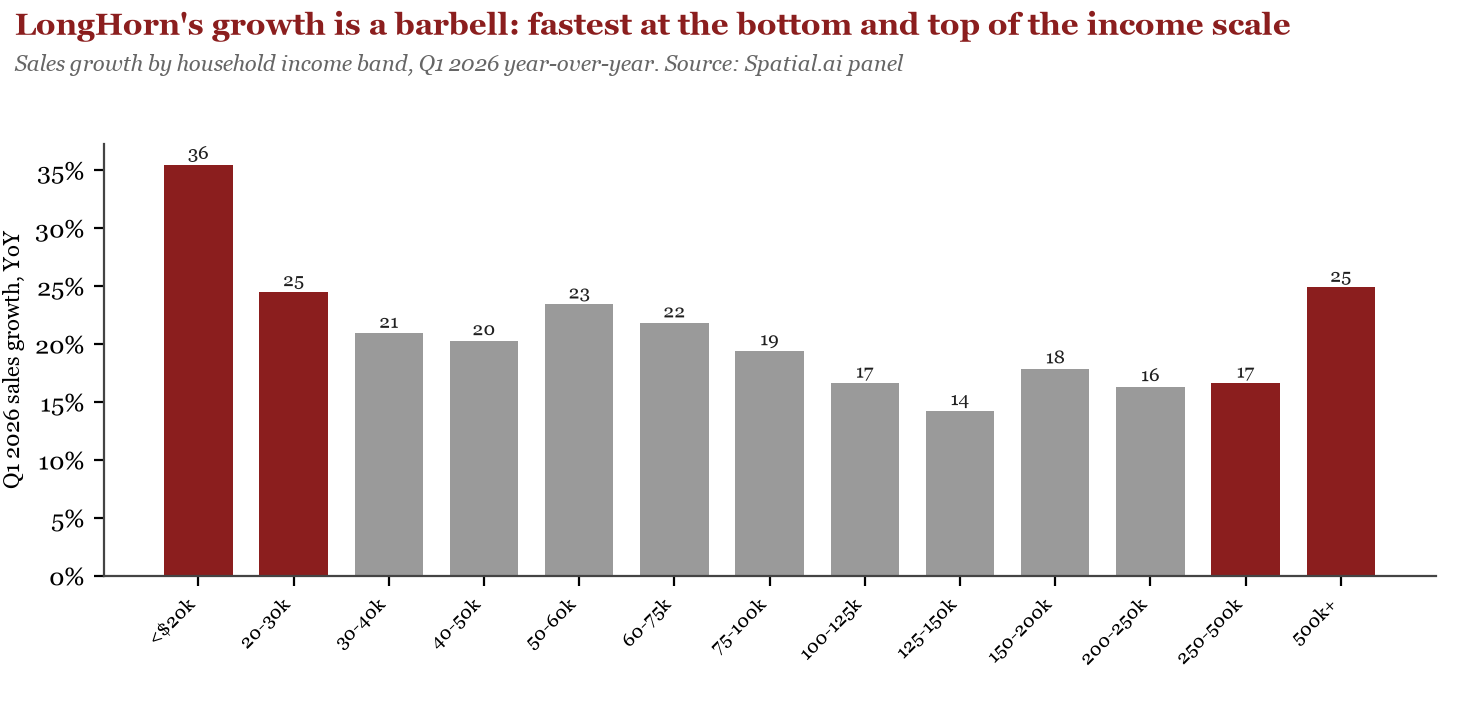
Growth at both ends of the income scale. Source: Spatial.ai panel.
The wallet is concentrating
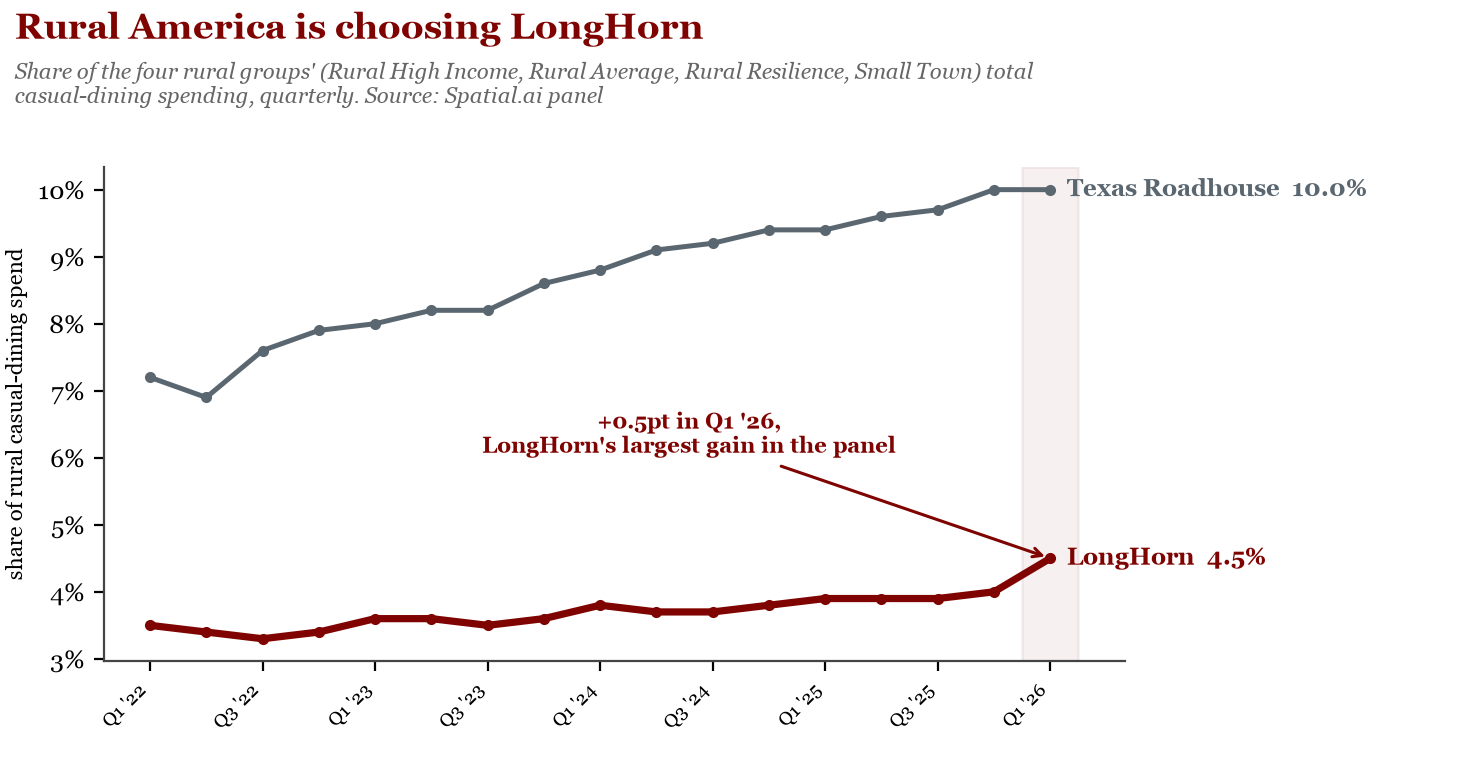
The rural core is where the value proposition lands hardest. Among the four rural customer groups, Rural High Income, Rural Average Income, Rural Resilience, and Small Town, the cohort both big steakhouses compete for hardest, LongHorn took 4.5% of all casual-dining spending in the first quarter of 2026, up half a point in a single quarter, its largest gain in the panel; Texas Roadhouse's rural share, still more than twice LongHorn's, stalled at 10%. Within the big-three steakhouse wallet, that puts LongHorn at roughly 26% of rural spending and climbing since late 2025. Rural customers are the cleanest cohort to watch because they are at the heart of both brands' bases, and in the first quarter the shift is unambiguous: the households with the most beef appetite and the least budget room are choosing the steakhouse that kept its value promise.
The consolidation beneath
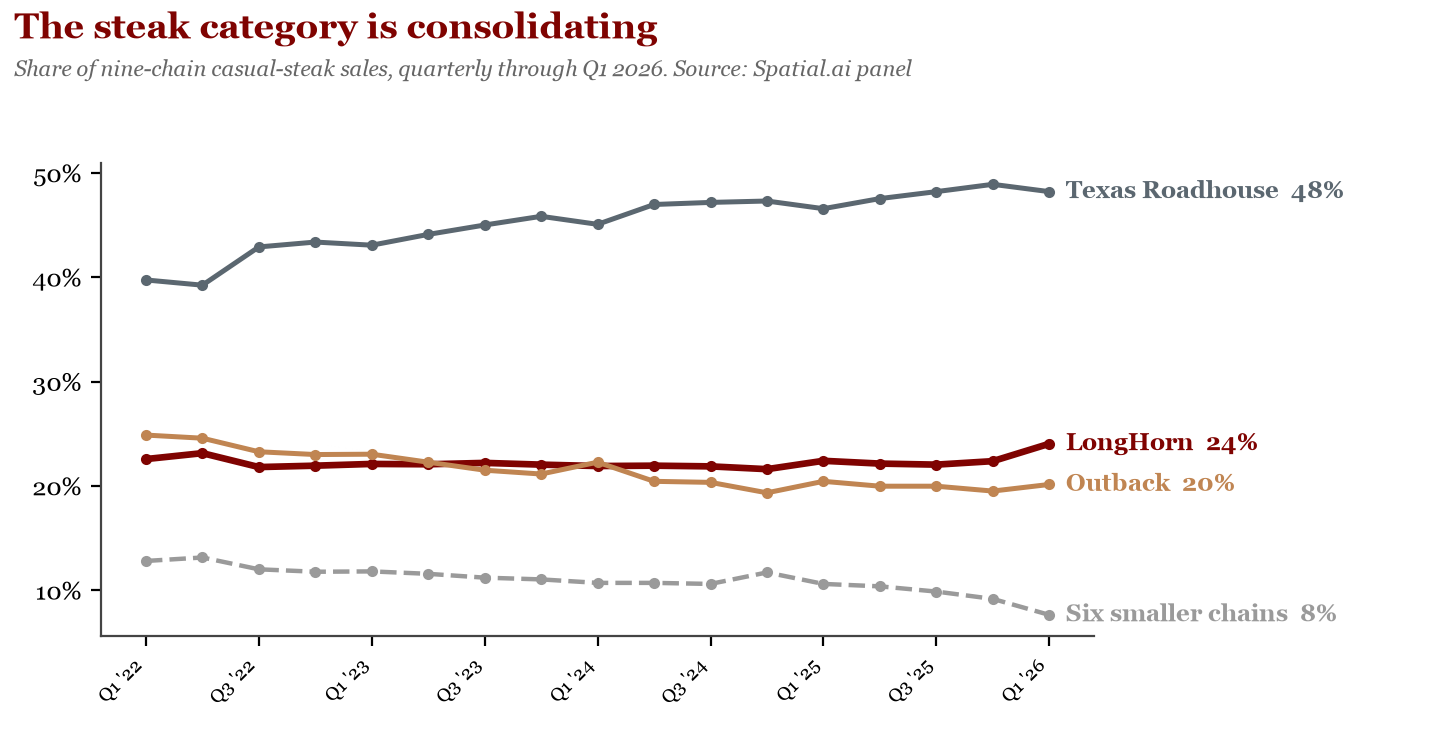
One more source is feeding the base. The six smaller full-service casual dining steakhouse chains, Logan's Roadhouse, Saltgrass, Colton's, Black Angus, Western Sizzlin, and Ponderosa, held 12.8% of the nine-chain steak wallet in 2022 and hold 7.5% now, a 40% collapse in their combined share as locations close across the mid-South. Their customers are small-town Southern and Midwestern steak eaters with nowhere local to go. LongHorn's share of the nine-chain wallet rose to 24% in Q1 2026, its highest in the panel, with nearly all of that gain arriving in the last year.
The limits
The same data marks the edges of the story. LongHorn remains thin with urban, young, and highly educated diners, its base skews old, and its growing tilt toward lower-income households is an exposure if the consumer weakens further: hit harder, these households cut further, and the value promise gets harder to keep. Those limits matter for how far the run can extend. They do not change what the four-year record shows: a customer base that got deeper in its core, wider at its value edges, and more concentrated on LongHorn within its own category spending, through exactly the years the grocery bill pressed hardest.
Competition
Three brands built the same business in the same corner of the country. Only one of them still points its whole budget at being a steakhouse. The consumer has figured that out and is starting to reward Longhorn for its focus.
VS Outback Steakhouse
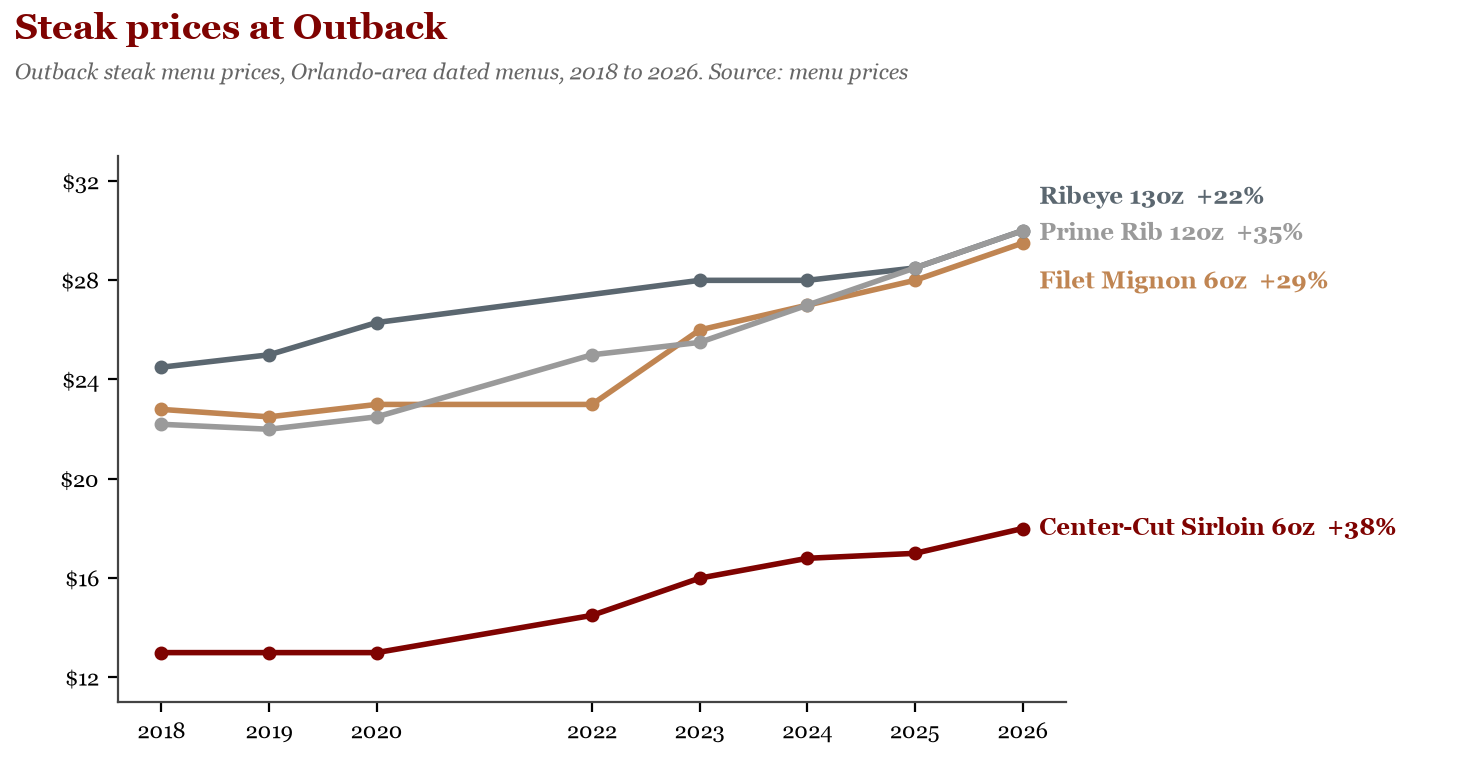
Outback has always carried the highest steak prices of the three, and it leaned on promotions and deals to keep the effective check down. Menu prices from its Orlando locations show the pattern plainly: prices climbed all along, roughly 15% across the steak menu from 2018 to 2023 even as the promotions ran, and then sprinted once costs caught up with the strategy. By 2026 its 6-ounce sirloin was up 38% from 2018, its 12-ounce prime rib up 35%, and its 6-ounce filet up 29%, with the sharpest single step arriving from 2025 to 2026. Those late increases were taken from necessity rather than strength, into traffic that was already falling, down 2.4% in the first quarter of 2026 per Bloomin's results. The chain that promised the deal was hit hardest by rising prices: promotions compressed margins while costs rose, discount-led marketing gave guests a reason to wait rather than return, and catch-up repricing arrived after guests had thinned.
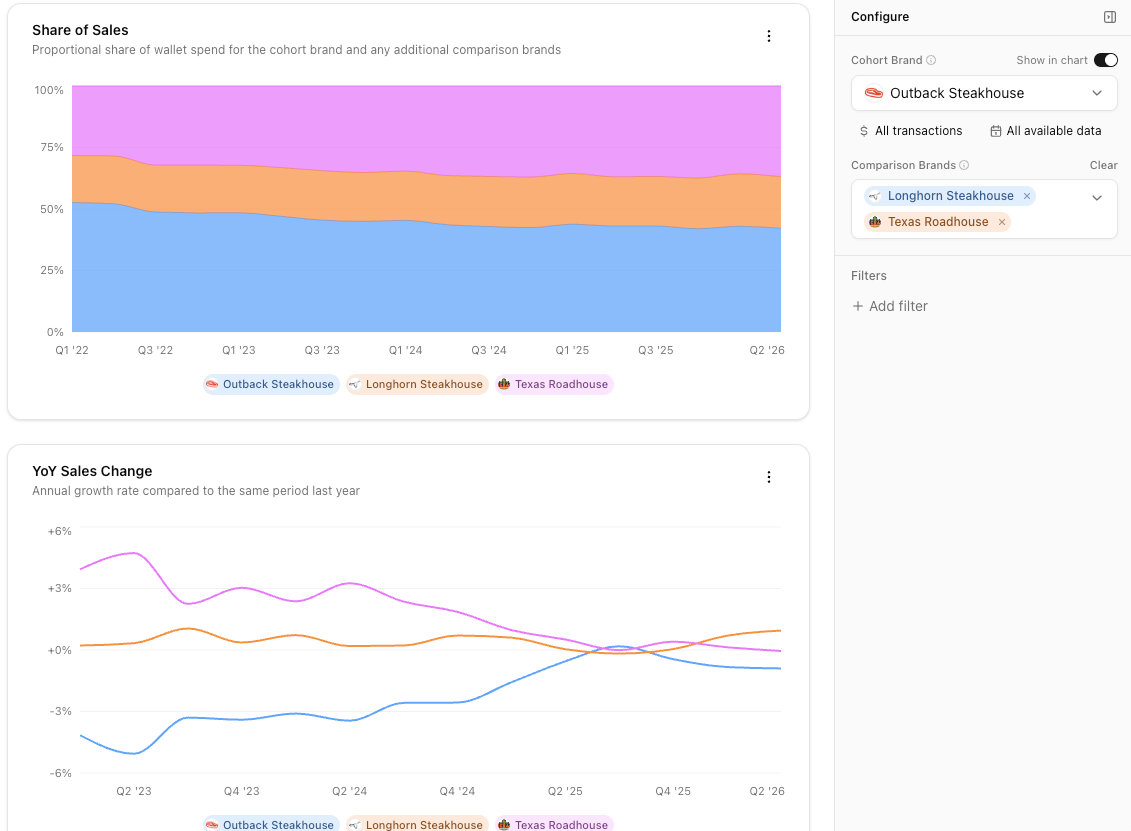
The damage shows up at the parent. Bloomin' Brands' stock has lost roughly three-quarters of its value since early 2024, trading under $7 by January 2026, as traffic declines forced repeated guidance cuts and the activist investor Starboard Value took a stake. The responses came in waves: roughly 41 US closures announced in February 2025 and more since, about 100 corporate roles cut in 2025, the December 2025 sale of 67% of its Brazilian business, its best asset, to Vinci Partners for $243 million to fund a $75 million US turnaround, and in November 2025 a suspended dividend, with free cash flow redirected into the restaurants. For the past four years Texas Roadhouse has been the biggest winner from the Outback fallout, but in this recent quarter Longhorn gained more.
VS Texas Roadhouse
Texas Roadhouse made the offensive choice a decade ago, the lowest prices in full-service dining, and won with it; it holds nearly half the nine-chain steak wallet. What it sells with those prices is a night out as much as a dinner. Its restaurants are built around a full bar with made-in-house margaritas, $5 beer and margarita specials all day every day, line dances, and country music on a loop, and its own filings celebrate bartenders and line dances as signature roles. The check reflects the occasion: Texas Roadhouse's average ticket is the lowest of the three, and its alcohol mix, 8.8% of restaurant sales per its 2025 annual report, is nearly identical to LongHorn's 8.5% per Darden's, but with $5 margaritas compared to LongHorn's cheapest at $12, that same share of sales represents far more bar orders per guest. The bar is priced as a traffic engine, not a profit center, and it defines which occasions and which customers the brand wins.
Its next choice is the revealing one: the cheaper drinks and the social atmosphere seem to be where the company's focus now sits, with its growth capital increasingly going somewhere other than steak. The company is developing three concepts, and its stated 2026 plan puts a growing share of roughly 35 openings into Bubba's 33, its sports-bar chain, and Jaggers, its fast-casual one, with management describing Bubba's as the vehicle it is "pressing the gas" on toward a long-term goal of hundreds of locations. Bubba’s customer set leans far more urban and hispanic than Texas. Its steakhouse still grows, but the company's ambition is visibly diversifying away from the category it leads, toward an even more bar-led format.
The customer data shows what that divided attention costs. In Q1 2026 LongHorn out-grew Texas Roadhouse in twelve of seventeen customer groups, and the gap was widest in the shared rural core: roughly double Texas Roadhouse's growth rate in Rural Average Income, Rural Resilience, Small Town, and Melting Pot Families. The five groups where Texas Roadhouse still grew faster, the ultra-wealthy, educated-urban, young-professional, and retiree edges, are the groups a bar-anchored night out courts, not a steakhouse's center. The pattern in the data matches the pattern in the capital: Texas Roadhouse is winning the customers its bar occasion and new concepts aim at and conceding momentum with the rural Southern and Midwestern steak customer both brands were built on.
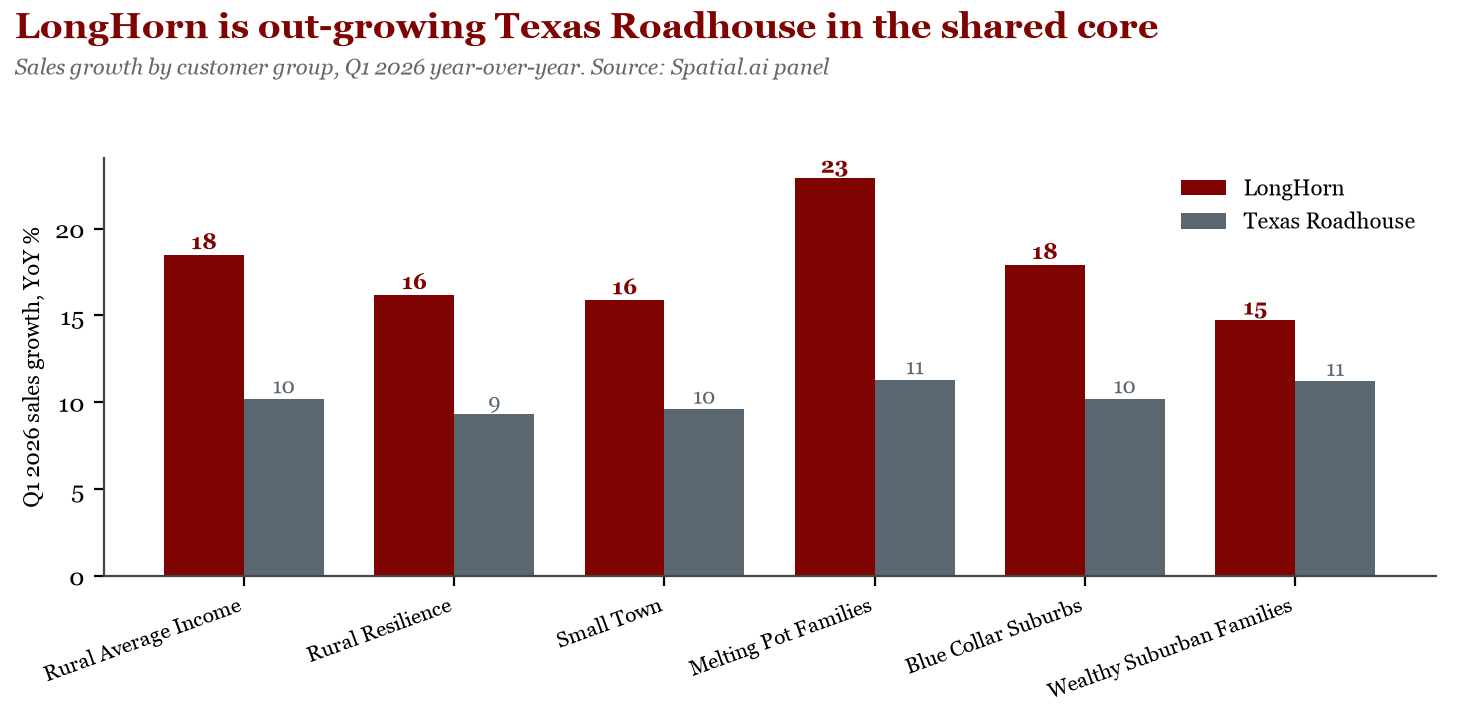
LongHorn is out-growing Texas Roadhouse in the shared core. Source: Spatial.ai panel.
Price, and what the customer got for it
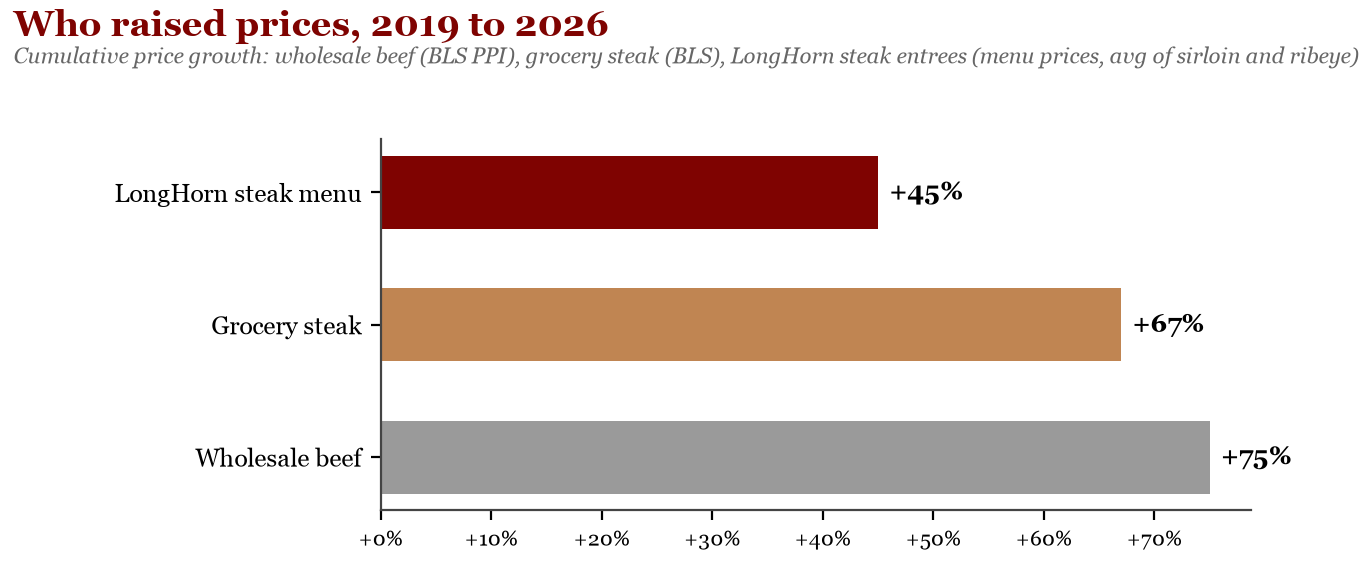
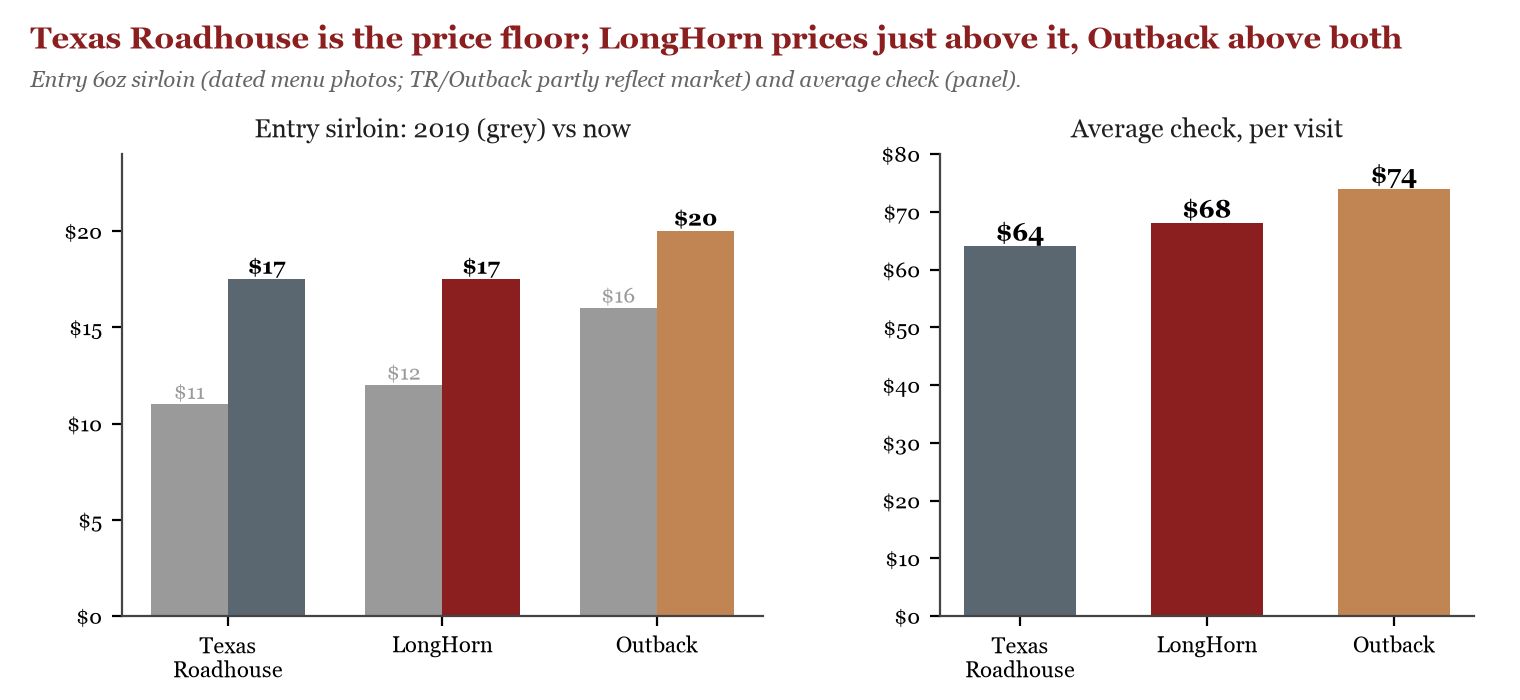
While LongHorn has similar prices to its competitors, it is not the cheapest. Texas Roadhouse's 6-ounce sirloin was $11 in 2019 to LongHorn's $12. LongHorn raised its steak entrees about 45% since 2019, more than Texas Roadhouse, yet well under the increase for both grocery steak, up 67%, and wholesale beef, up 75%, and it gained share the entire time. What the increases bought differed. LongHorn's pricing stayed below the meat case's inflation while funding larger portions and better execution; guest value improved even as prices rose. Outback's promo-led pricing funded discounts rather than the plate, and its value proposition eroded as its traffic declined.
Price is not the whole strategy; maximizing value is. On 2026 menus, the three brands' steak prices sit within a few dollars of each other; a 6-ounce sirloin runs $17.49 at both LongHorn and Texas, and $17.99 at Outback. Nobody is winning this category on the menu price alone. The average checks differ more than the steaks do: $68 at LongHorn versus $63 at Texas Roadhouse, whose lower check likely reflects the bar crowd and its cheaper drinks. Alcohol shares are nearly the same, which points the difference back to what is being ordered: more of the check at LongHorn is for food. What LongHorn's customer is buying is specific. They want a serious steakhouse, the hand-cut steak, the correct temperature, the fine-dining cut, without paying a serious steakhouse's check, and LongHorn is the closest in the category to that.
Coverage
Three footprints, moving in three directions
The three brands' restaurants blanket the same eastern half of the country, but the footprints are not equivalent. Texas Roadhouse spreads west and owns Texas. Outback concentrates in Florida and the urban Southeast. LongHorn runs from Georgia up the Appalachian spine and across the Midwest, the densest overlap with the belt where America eats the most beef on the smallest household incomes.
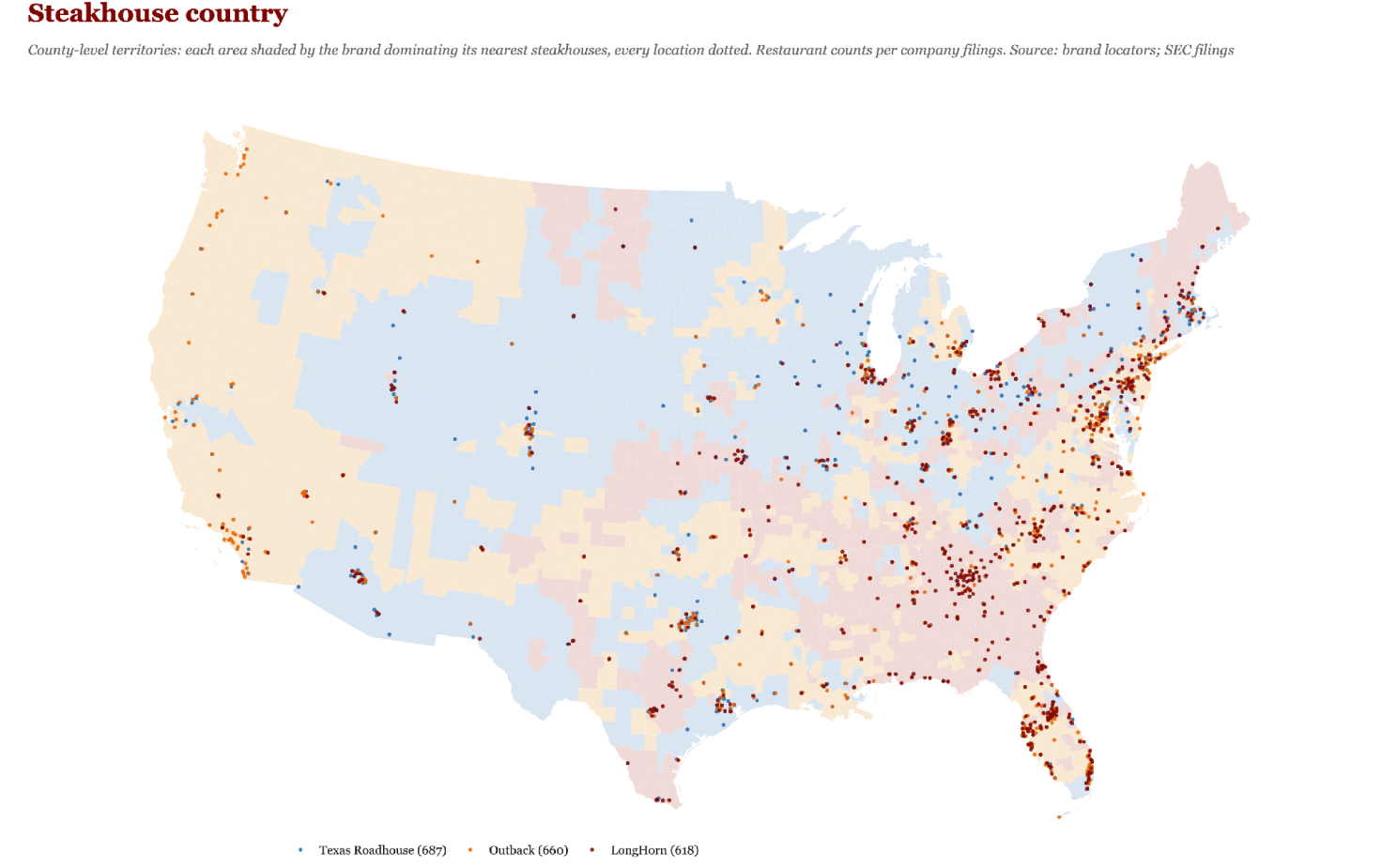
Steakhouse country: county-level territories shaded by the brand with the most nearby steakhouses, every location dotted. Source: brand locators.
LongHorn's revenue share confirms the geography. Georgia, its birth state, and Florida are its two anchors, together more than a fifth of its sales, with Ohio, Pennsylvania, Tennessee, and the Carolinas behind them. The brand is effectively absent west of Texas, and its Texas share, 6.7% of revenue in the largest restaurant state in America, is small relative to the market. That gap is addressable, and LongHorn's newest openings include Texas locations, but today the brand is a Southeastern and Midwestern business.
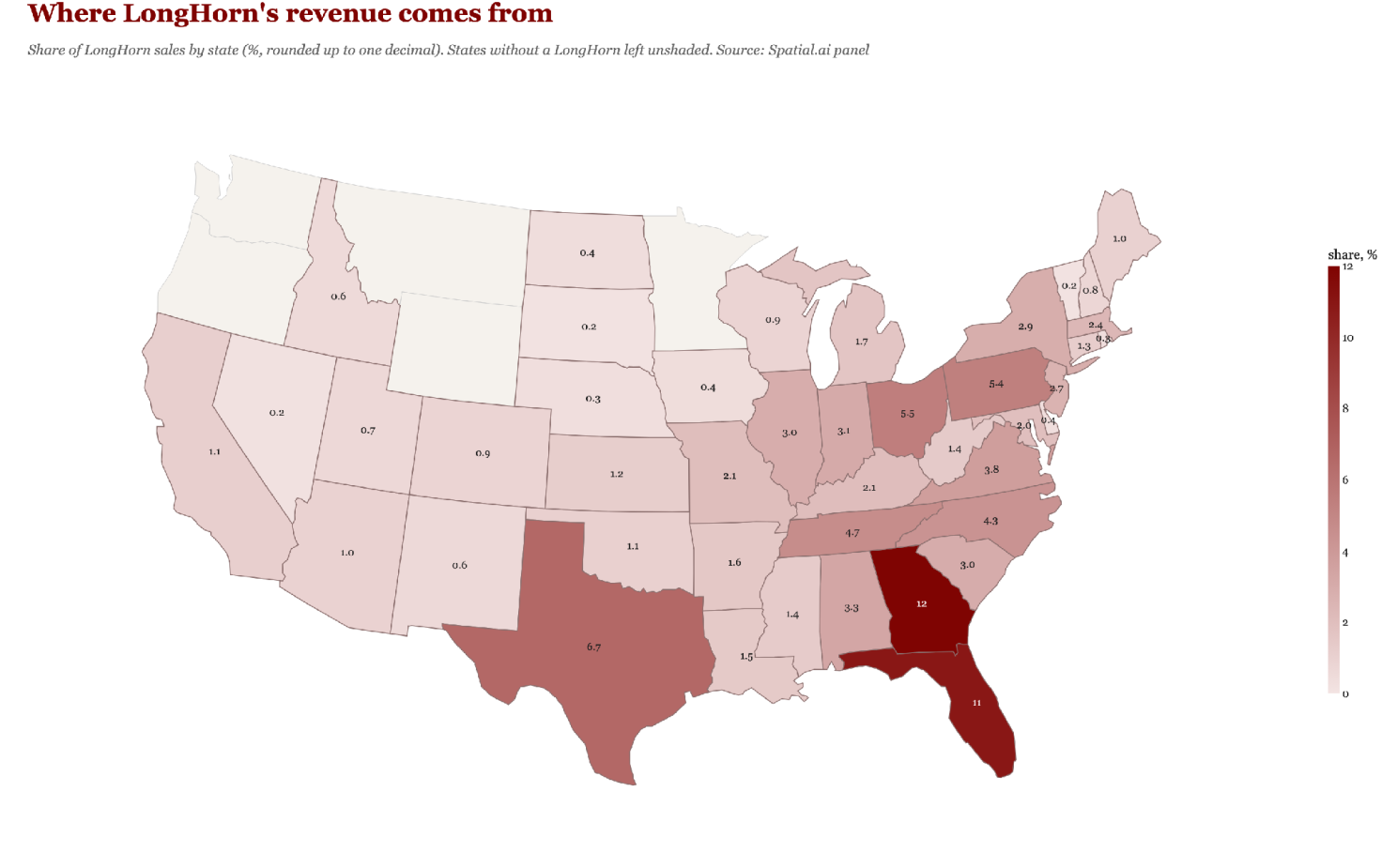
Where LongHorn's revenue comes from. Source: Spatial.ai panel.
Who lives where each brand is moving
The direction of each footprint matters more than its current shape, and the residential data around LongHorn's newest doors and Outback's closed ones tells both stories at once. LongHorn's recent and announced openings sit in trade areas that over-index hardest for Small Town households at 2.4 times the national average, Blue Collar Suburbs at 2.2, and Young Urban Singles at 1.7, its small-town Southern and Midwestern core plus the younger households its 2026 growth is already pulling in. Outback's closures cluster in the opposite neighborhoods: City Hopefuls at 1.7 times average, Young Urban Singles at 1.5, Near-Urban Diverse Families at 1.4, the urban and near-urban areas where its format connected least. One brand is building toward the customers it is winning. The other is retreating out of the neighborhoods it already lost.
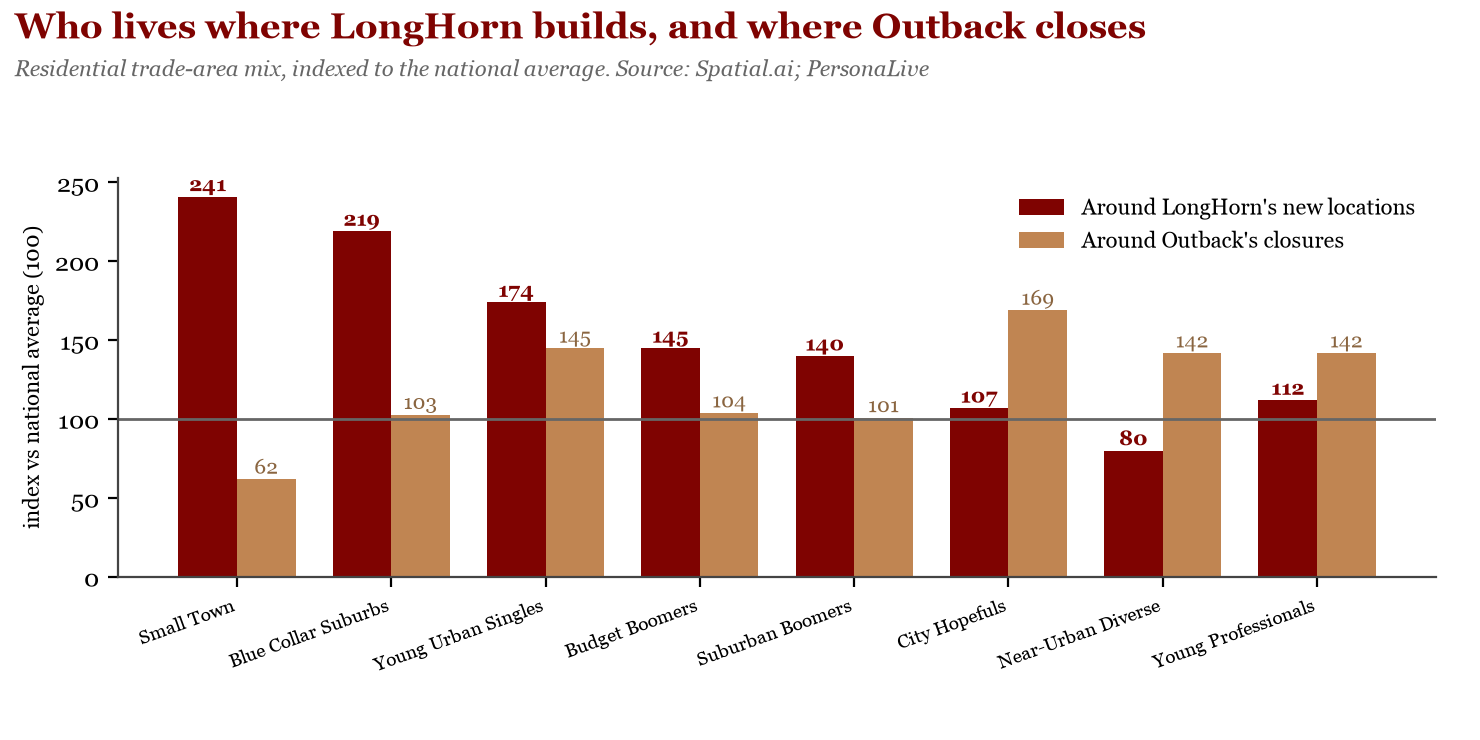
Who lives where LongHorn builds, and where Outback closes. Source: Spatial.ai; PersonaLive.
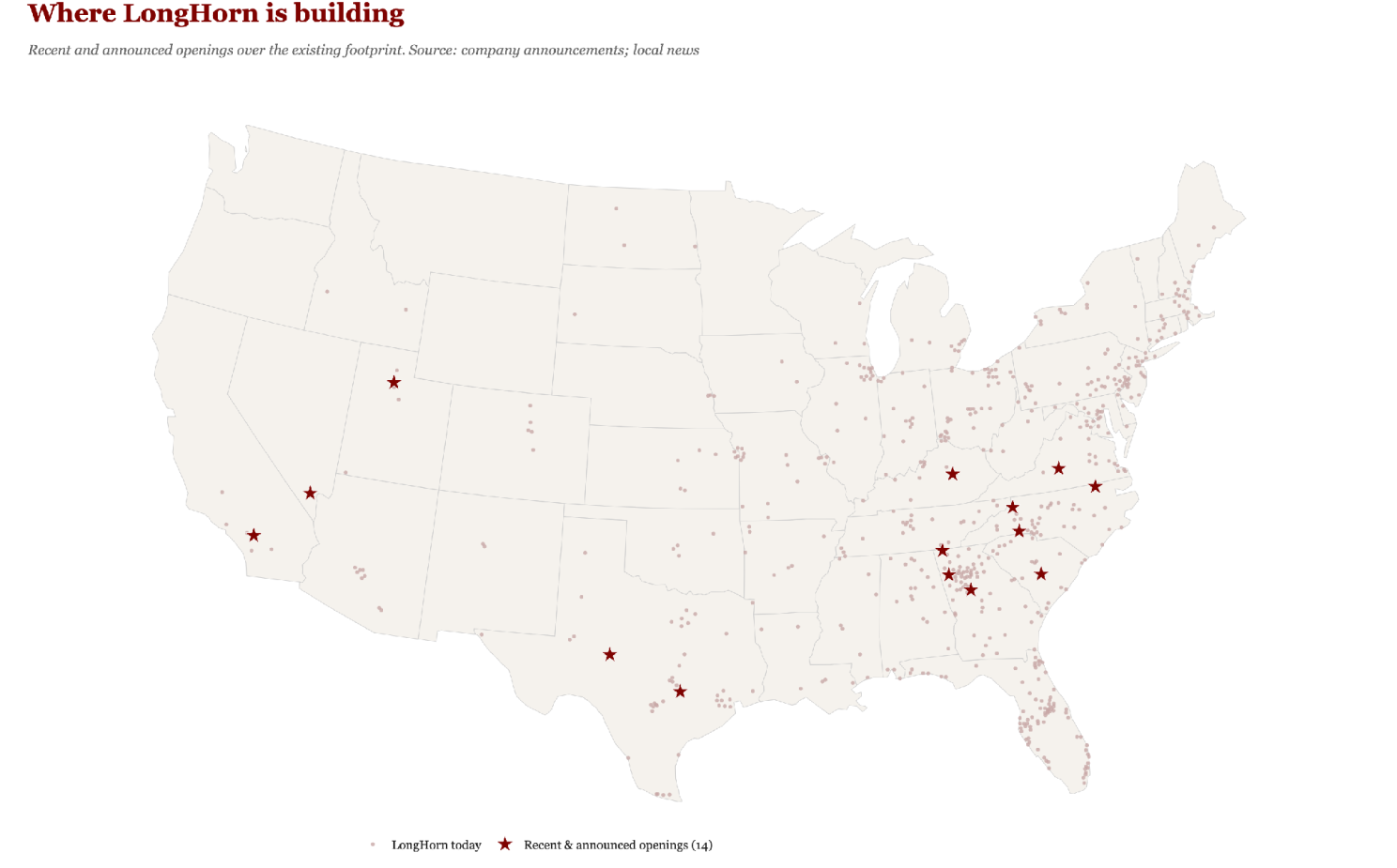
Where LongHorn is building. Source: company announcements.
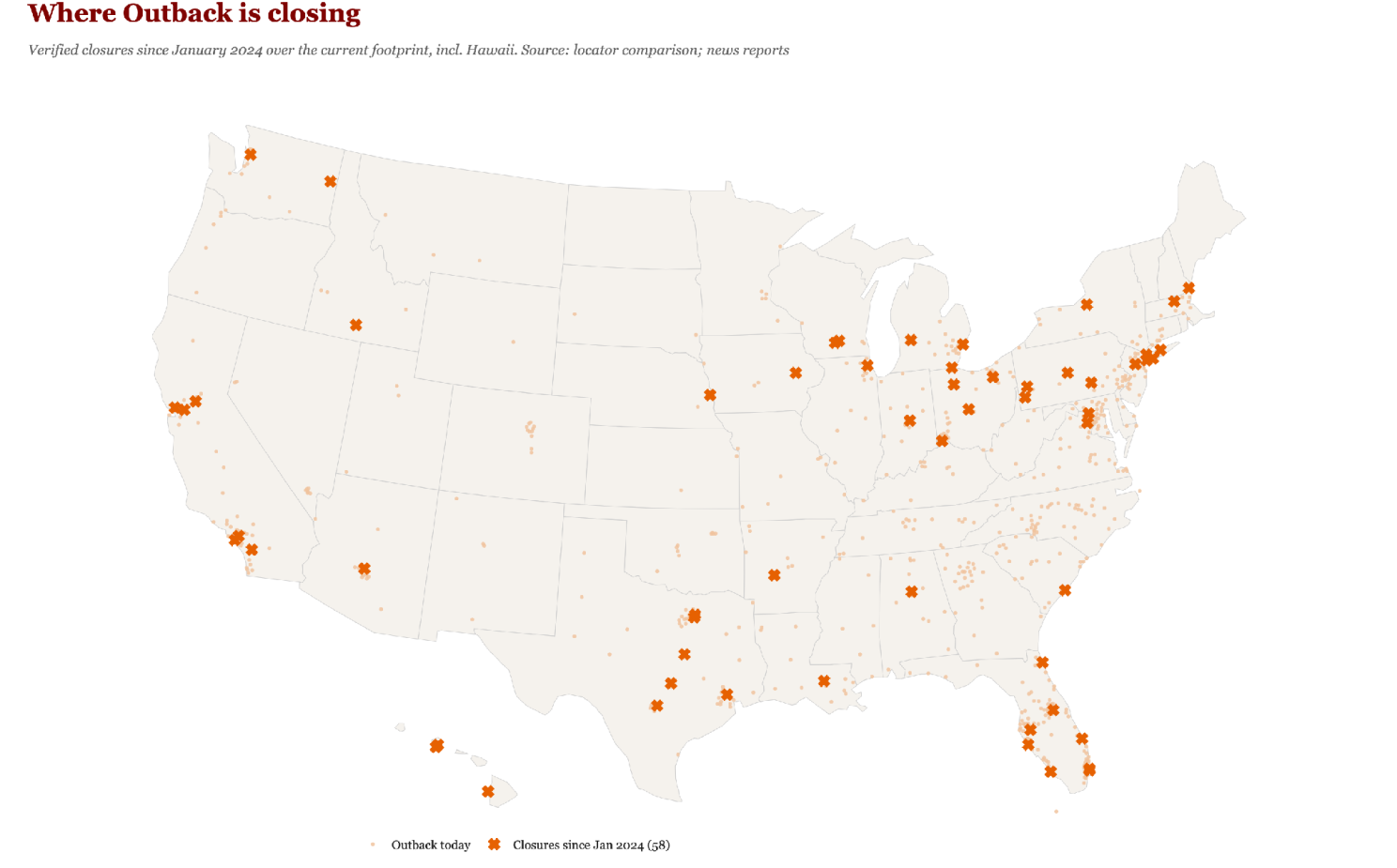
Where Outback is closing. Source: locator comparison; news reports.
At least 58 US Outback locations are gone since the start of 2024, and those closures pave the way for LongHorn's expansion: every shuttered door in the shared corridor releases customers whose nearest equivalent steakhouse is most often a LongHorn. Texas Roadhouse, meanwhile, is putting roughly $400 million into development in 2026, its most aggressive building year, but spread across three concepts. The most telling line in its plan is the deliberate California push. Texas Roadhouse is spending to grow where it already wins a different customer: the coastal, urban, higher-income diner who comes for the room, the bar, and the rolls more than for the steakhouse itself. The two growth maps describe the two strategies: LongHorn is building deeper into the customers who choose a restaurant because it is a steakhouse; Texas Roadhouse is building toward the customers who choose it despite that. The steakhouse map, specifically, is being ceded by one rival and pointed away from by the other.
Where each brand builds next
The 2026 expansion classes make the split concrete. Around LongHorn's announced openings and Texas Roadhouse's named 2026 sites alike, trade areas over-index for Small Town and Blue Collar Suburb households; both brands are still building into working-class America. The difference is at the edges. Texas Roadhouse's class leans on border-market Melting Pot Families at 1.9 times the national average against LongHorn's 0.8, driven by new sites in Laredo, Weslaco, and other Texas border markets, while LongHorn's leans young urban-adjacent, Young Urban Singles at 1.7 against Texas Roadhouse's 1.1. Same heartland base, different frontiers.
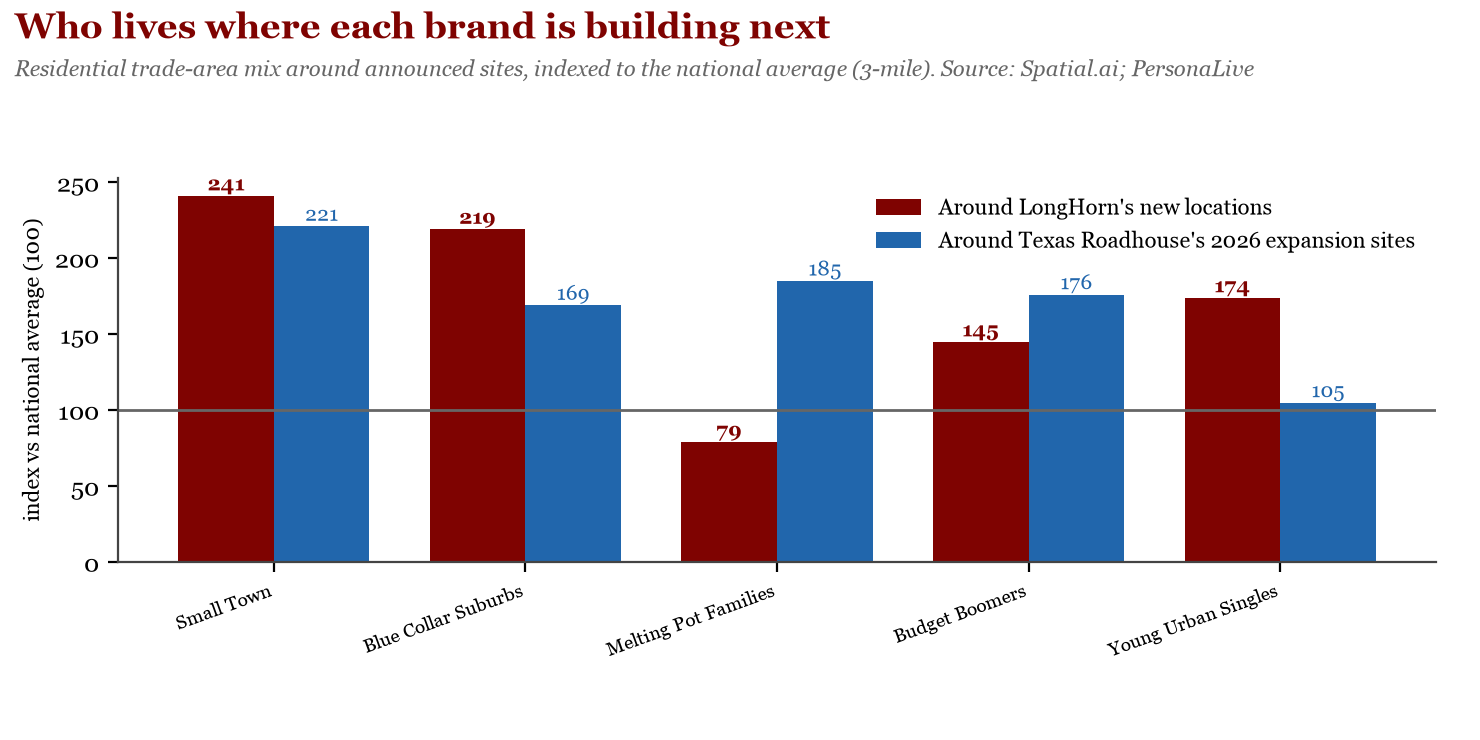
Who lives where each brand is building next. Source: Spatial.ai; PersonaLive.
Campaign
The plate is the campaign
LongHorn's marketing strategy is to spend where the guest can taste it. Over the past decade Darden moved the brand away from price promotions and put the money into portions, quality, and execution, a strategy its CEO has described in plain terms: "we weaned off the communication and put more on the plate per dollar than everybody in the space." The claim is checkable in the operating data. LongHorn runs no points program or discount loyalty scheme. Darden's stated view is that discount programs train guests to wait for the offer rather than return for the food. What it builds instead is consistency: steaks cooked to the ordered temperature at record rates by its own internal measure, portions that grew as rivals' shrank, and menu prices held below grocery inflation. This consistency works: guests return every 105 days against rivals' 120, traffic outruns the industry, and market share rises without a discount in sight.
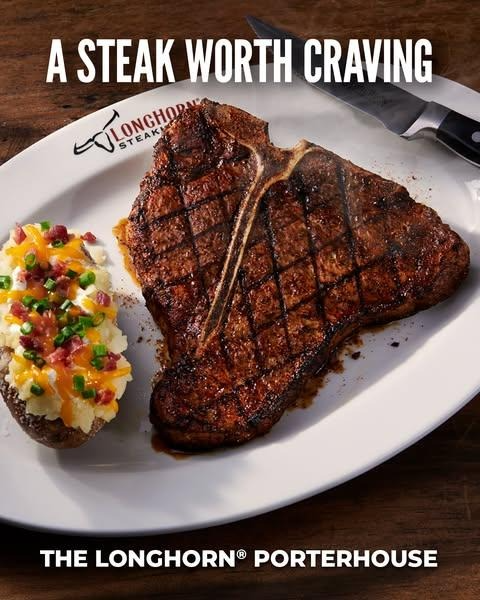
When LongHorn does buy advertising, the creative sells the same thing the operation does. Its ads are close-ups of the food, the sear on the steak, the portion against the plate, with the brand name attached, not a price point, not a limited-time offer, not a coupon code. The message and the strategy are one sentence: the steak is the reason to come.
The clearest recent proof that this engine works is the lamb. LongHorn's Parmesan-crusted lamb chops are a seasonal item with a following, and in early 2026 the brand's social tease of their return spread on its own, reposted across Instagram and X through March and April by food accounts and regulars announcing the news to each other. The company's paid contribution was a social post; the audience did the distribution. Per Cardenas on the Q4 fiscal 2026 call, Darden bought more lamb than the prior year and sold through it in half the usual time. That is the model in miniature: a product worth announcing, announced cheaply, converting immediately. Campaigns work for LongHorn when they run, precisely because they are rare enough, and food-first enough, to be news.
The spending gap
The three brands buy attention in three different ways, and their budgets show it. Bloomin' Brands spent $111 million on advertising in 2024, close to 3% of its revenue, most of it the national price-point advertising Outback is now walking away from. Texas Roadhouse spent $35 million in 2025, about 0.6% of revenue, the lowest in the category. Darden spent $170 million across its eight brands for the 2025 fiscal year, about 1.4% of revenue, with LongHorn's share of that concentrated in food-forward creatives rather than promotions.
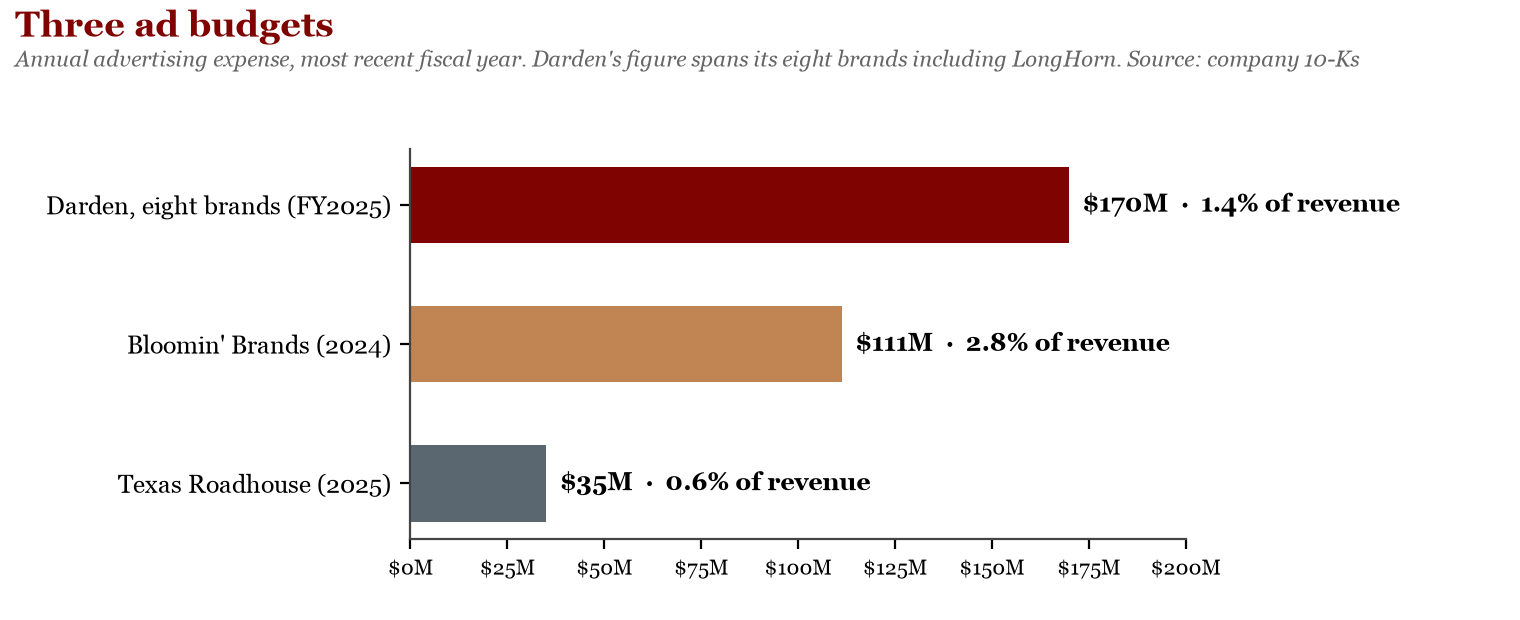
Three ad budgets. Source: company filings.
Texas advertises store by store
Texas Roadhouse's $35 million is small because the model is local. The company runs almost no national media; each restaurant's managing partner doubles as its marketer, sponsoring schools, youth teams, charity nights, and community events market by market, and the creative that reaches guests is a donate-night flyer or a local sponsorship poster, not a network spot. The experience does the rest of the marketing, and it is programmed deliberately: unlimited rolls, line dancers in the aisles, country music at volume, $5 margaritas. It is the cheapest customer acquisition in the category and it has worked for decades. Its dependency is the occasion itself, a social night out anchored by the bar, and the company is doubling down on that anchor by pushing its marketing energy and development capital into Bubba's 33, its sports bar brand.

Outback's playbook, in its own words
Outback was overly dependent on promos and discounts to drive visitation, national advertising built on price points and limited-time offers, creative that led with the number: "3-Course Meal starting at $14.99," the dollar figure drawn larger than the food. Its own parent has now repudiated the approach. Bloomin's turnaround plan, announced in November 2025, explicitly shifts tens of millions of dollars away from promotional discounting and into food quality and portion sizes, with management telling investors the brand had become too dependent on discounts to drive traffic. Outback is conceding the argument and attempting to adopt LongHorn's model: center-of-the-plate quality first, promotions second, years behind it. Whether Outback can execute the model matters less to 2026 than when it started: the traffic data, down 2.4% in Q1, prices its lateness, and the turnaround is the thing to watch through 2027.
Three campaigns, one scoreboard
The three approaches resolve to a simple contrast. Outback marketed the deal, is paying to unwind it, and is now trying to become what LongHorn already is. Texas Roadhouse markets town by town, through its stores and sponsorships, and is betting its next decade on a more bar-led version of the night out. LongHorn markets being a steakhouse, first and foremost; that is the priority every dollar reinforces, and in this beef market it is the only one of the three positions that gets stronger on its own. Every dollar beef inflation adds to the grocery store's price makes LongHorn's held-down, portion-forward menu a stronger advertisement.
Conclusion
The verdict
American beef is the most expensive it has ever been; that condition will not clear quickly. The households that eat the most beef are also the households with the least room in their budgets, concentrated in the South, Appalachia, and the small-town Midwest. The high-priced meat case has been pushing these consumers toward the restaurant. Among the restaurants positioned to receive them, one spent a decade preparing: menu prices held below grocery inflation, portions grown while rivals shrank, beef costs hedged through the largest full-service restaurant company in America, no discounts to train guests to wait, and a footprint concentrated exactly where the pushed households live. 14% growth within a category that did not grow at all, the highest among the ten largest casual-dining chains, with share gains against both rivals at once and guests returning every 105 days against rivals' 120, is the result of LongHorn navigating a stressed economy and a stressed customer, and delivering on what it promised.
The Playbook
Value-first messaging came first: for years LongHorn has positioned itself as a steakhouse before anything else, promising the customer the best steakhouse experience in dining and food quality. Darden's scale made the promise affordable: buying for 2,200 restaurants across its brands, it locked 80 to 85% of quarterly beef at fixed prices and gave LongHorn a competitive advantage over the category on food inflation. And the brand delivered on the promise: price increases stayed under the overall food inflation rate, portions grew as rivals' shrank, and the value promised to an increasingly value-conscious customer base kept showing up on the plate.
What to watch
Outback is attempting the turnaround its parent announced in November 2025: dividends suspended, free cash flow redirected into the restaurants, $75 million funded by selling most of its Brazilian business, tens of millions shifted from promotional discounting into food quality and portions. The plan seems to be LongHorn's model, adopted late, and its success is possible long-term. What is not open is the near term: the menu was repriced late into falling traffic, at least 58 US locations have closed since the start of 2024, and every closure in the shared Southeastern corridor releases customers whose nearest equivalent steakhouse is most often a LongHorn. Whether Outback recovers in 2028 or continues to shrink, LongHorn will collect through 2026 and into 2027, and it will be important to track what Bloomin' Brands adopts as a corporate strategy.
Texas Roadhouse remains the category's largest and healthiest rival, and its plan is the most explicit: a record $400 million of 2026 development spread across the roadhouse as well as its bars, its fast casual concept, and new untested markets, with Bubba's 33 the growth vehicle management is "pressing the gas" on and a deliberate California push. They are betting on a different customer than the steak-first household both brands were built on. The panel already shows the trade: LongHorn out-growing it in twelve of seventeen customer groups, at roughly double its rate in the shared rural core, while Texas Roadhouse's wins concentrate in the urban, young, and affluent edges its new concepts court. If the divergence holds, the steak-first customer consolidates on LongHorn while Texas Roadhouse grows a different company beside it.
The risk is the customer itself. LongHorn's base skews old and lower income, the groups most susceptible to economic stress. If overall food and beef inflation continue and the squeeze deepens, there is a real chance LongHorn cannot keep delivering on the value promise its rural base now expects, and the same tilt that powered the breakout becomes the exposure.
Forecast
LongHorn's plan stays simple: 25 to 30 new steakhouses a year, all one concept, opened into trade areas that over-index for its best customers at more than twice the national average, plus fiscal 2027 beef already partly locked. And beneath all three plans runs the beef market: the herd rebuild is a multi-year process that reduces supply before it adds any, imports are tariff-constrained, and grocery steak stays historically expensive on any credible timeline. The conditions that converted LongHorn's structure and strategy into market share gains seem likely to persist: expect the Q1 growth to continue through the rest of 2026 and into 2027.
Get the data that powered this teardown here.
Written by: Daniel Paulson-Luna
Edited by: Lyden Foust
What you should do now
Whenever you're ready, here are 3 ways Spatial.ai can help:
- See PersonaLive In Action. If you'd like to segment and target your best customers using real-time behavioral data, schedule a free 30-min demo to get started.
- Subscribe To Consumer Code. If you've found this helpful, check out our newsletter and podcast where we share more consumer research and insights for retail marketers.
- Share This Post. If you know another marketer who’d enjoy reading this post, share it with them on Linkedin, X, or Facebook.
Get retail marketing tips
We email every monday with smart growth strategy ideas. Almost no promotion. Just value.
.avif)
%20(1).jpg)