Dunnhumby's 2026 Retailer Preference Index Out Today - Convo With Author Erich Kahner

I just finished a podcast with Erich Kahner, author of Dunnhumby’s Retailer Preference Index (RPI), and it’s something every retailer should read to start 2026.
RPI surveys 11,000+ consumers to measure how effective a retailer’s value proposition really is, across five pillars (savings, quality, digital, operations, speed & convenience) and 32 levers. Then directly links those perceptions to real financial outcomes through sales data.
What I love about RPI is that it’s not just a report card; retailers in the top quartile grow roughly 3x faster than those in the bottom quartile, making it a roadmap for market share growth.
Although the public report is grocery focused - the customer preferences are broadly applicable. After reading it last year it illuminated quite a few phenomena I saw happening in our spend in psychographic data.
Here are four takeaways widely applicable retail take aways from Dunnhumby’s 2026 RPI work (and my conversation with Erich) that every retailer should be planning around right now. You can dig into the RPI here.
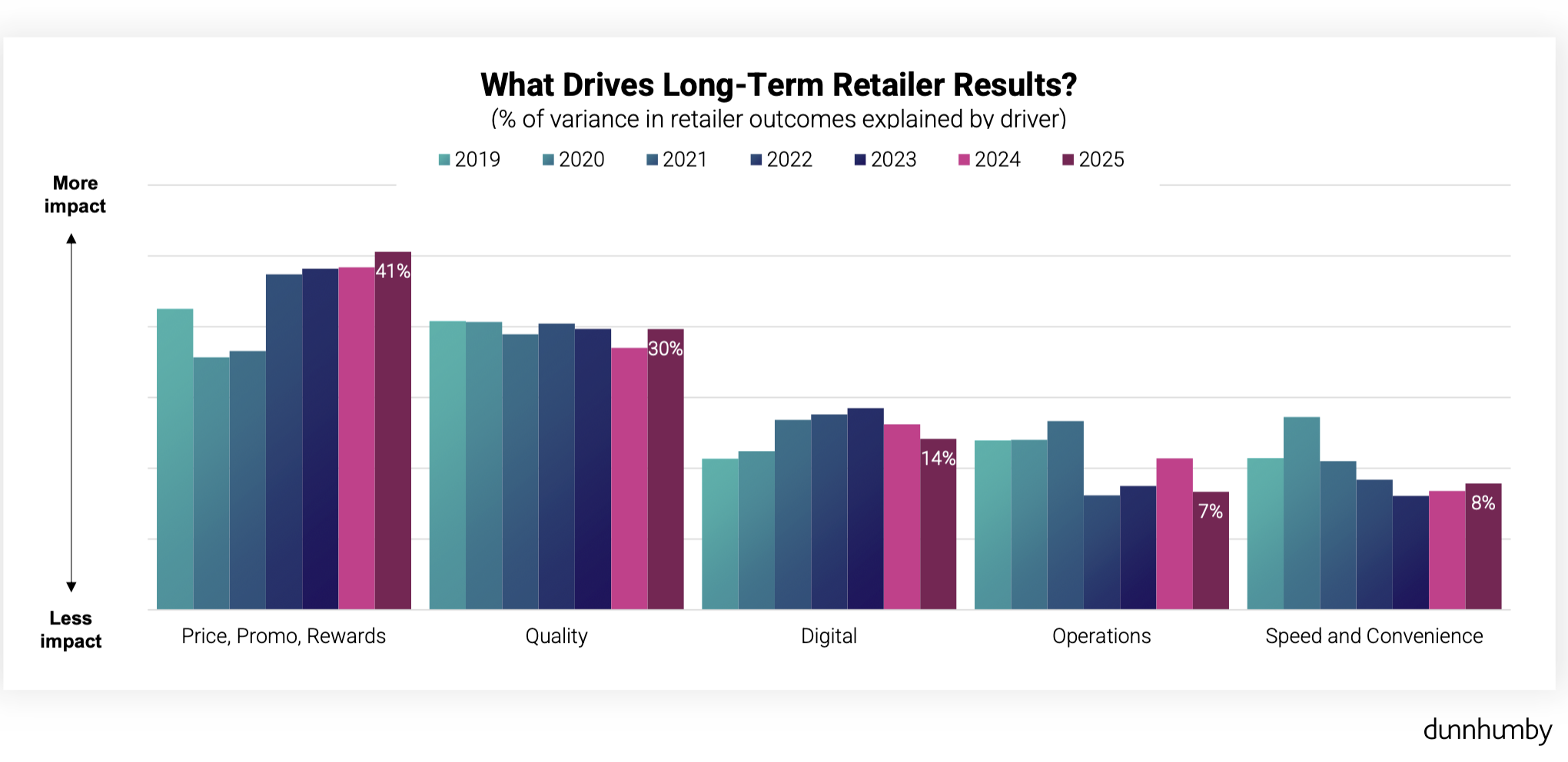
1) In 2026 America Price + Quality combo beats digital, operations, speed. Relating the % variance in retailer outcomes explained, Dunnhumby found in 2026 Price was #1 - Explaining 41% of variance, Quality was #2 explaining 30% of variance, followed by digital, operations, and speed.
Action: Don't assume a digital revamp is going to make a difference to consumers in 2026. Focus first on ensuring a competitive price for your tier of quality product.
2) Base-price trust is the new battleground. In previous years promos and rewards played a major part. Not 2026. Shoppers are judging retailers on: "Are you low-priced without gimmicks?".
Action: In 2026 consumers are going to pay closer attention to core comparable products. In grocery it might be eggs & milk. In Athleisure its leggings. Periodic discounts won't work as well as they did before so nail a price you can stand behind.
3) In 2026 consumers are more discerning (tools + frustration changed them). Digital tools like grocer apps have made comparison shopping frictionless, while years of inflation have reset shoppers’ internal price benchmarks. The result is a more attentive, less forgiving consumer, one who notices base prices, questions value, and is quicker to switch retailers to regain a sense of control.
Action: Assume customers are comparing you in real time. Choose the "missions" or "jobs-to-be-done" you want to win, and focus visably winning that battleground.
4) The barbell shopper is accelerating. More customers are splitting trips across the extremes: Savings-First for staples + Quality-First for specific missions. The “middle” feels less compelling unless it’s sharply differentiated. They are fine to make multiple shopping trips (or in the case of my wife multiple Instacart orders) as long as they are getting the value.
Action: As Steve Dennis has been saying for a decade -the average middle-of-the-road basket is disappearing. Take a look at the 32 drivers in the RPI report. Consider which of these drivers is losing you marketshare locally or regionally. Re-orient resources.
5) Savings is important nationally, but not equally distributed. One of the findings I found most fascinating is that savings matters most for Columbia, Canada, and the US. This is not true for places like Germany, Italy, and the Netherlands - and is closely related to financial insecurity. The actionable part of this is Dunnhumby breaks down US markets where food and financial insecurity are at their highest.
Action: You'll want to lean into savings and quality differently based on geography. The drivers losing you marketshare in one market may not be the key ones in another.
So much detail to cover - you'll want to pick up a copy of the RPI yourself, you can do that here: https://www.dunnhumby.com/resources/reports/retail-trends/en/9th-annual-retailer-preference-index-rpi-for-us-grocery/
What you should do now
Whenever you're ready, here are 3 ways Spatial.ai can help:
- See PersonaLive In Action. If you'd like to segment and target your best customers using real-time behavioral data, schedule a free 30-min demo to get started.
- Subscribe To Consumer Code. If you've found this helpful, check out our newsletter and podcast where we share more consumer research and insights for retail marketers.
- Share This Post. If you know another marketer who’d enjoy reading this post, share it with them on Linkedin, X, or Facebook.
Get retail marketing tips
We email every monday with smart growth strategy ideas. Almost no promotion. Just value.
.avif)
%20(1).jpg)